Memory leak of TString.tensorOf(Shape shape, DataBuffer<String> data)
Chưa có ai nhận issue này.
- Ngôn ngữ chính
- Java
- Star
- 928
- Fork
- 227
- Chỉ số merge pull request
- Không có pull request nào được merge trong 30 ngày
Mô tả
Please make sure that this is a bug. As per our GitHub Policy, we only address code/doc bugs, performance issues, feature requests and build/installation issues on GitHub. tag:bug_template
System information
- Have I written custom code (as opposed to using a stock example script provided in TensorFlow):
Yes - OS Platform and Distribution (e.g., Linux Ubuntu 16.04 x86_64):
macOS 11.5.2 - TensorFlow installed from (source or binary):
Binary - TensorFlow version (use command below):
2.5 - Java version (i.e., the output of
java -version):Java HotSpot(TM) 64-Bit Server VM (build 25.261-b12, mixed mode) - Java command line flags (e.g., GC parameters):
-ea - Python version (if transferring a model trained in Python):
3.7 - Bazel version (if compiling from source): N/A
- GCC/Compiler version (if compiling from source): N/A
- CUDA/cuDNN version: N/A
- GPU model and memory: N/A
- Tensorflow Java version:
0.3.2
Describe the current behavior
When I create and destroy TString instances repeatedly in a for loop, memory usage grows. In my production environment, where a TF model is served by a java service, it would cause memory usage alert after processing certain amount of requests.
Describe the expected behavior
Memory usage should not grow since created TString instances are closed in each iteration.
Code to reproduce the issue
    @Test
    void testPerformance() throws Exception {
        // Some code to load a model but never used it in this test case. Otherwise, the following code would exit randomly. See https://github.com/tensorflow/java/issues/370 .
        final String[] result = new String[] {"a", "b", "c", "d", "e", "f", "g", "h", "i", "c", "c", "c"};
        for (int i = 0; i < 65536; ++i) {
            try (final TString tstring = TString.tensorOf(Shape.of(1, result.length), DataBuffers.ofObjects(result))) {
               // this block is empty.
            }
        }
  }
Other info / logs
4 iterations
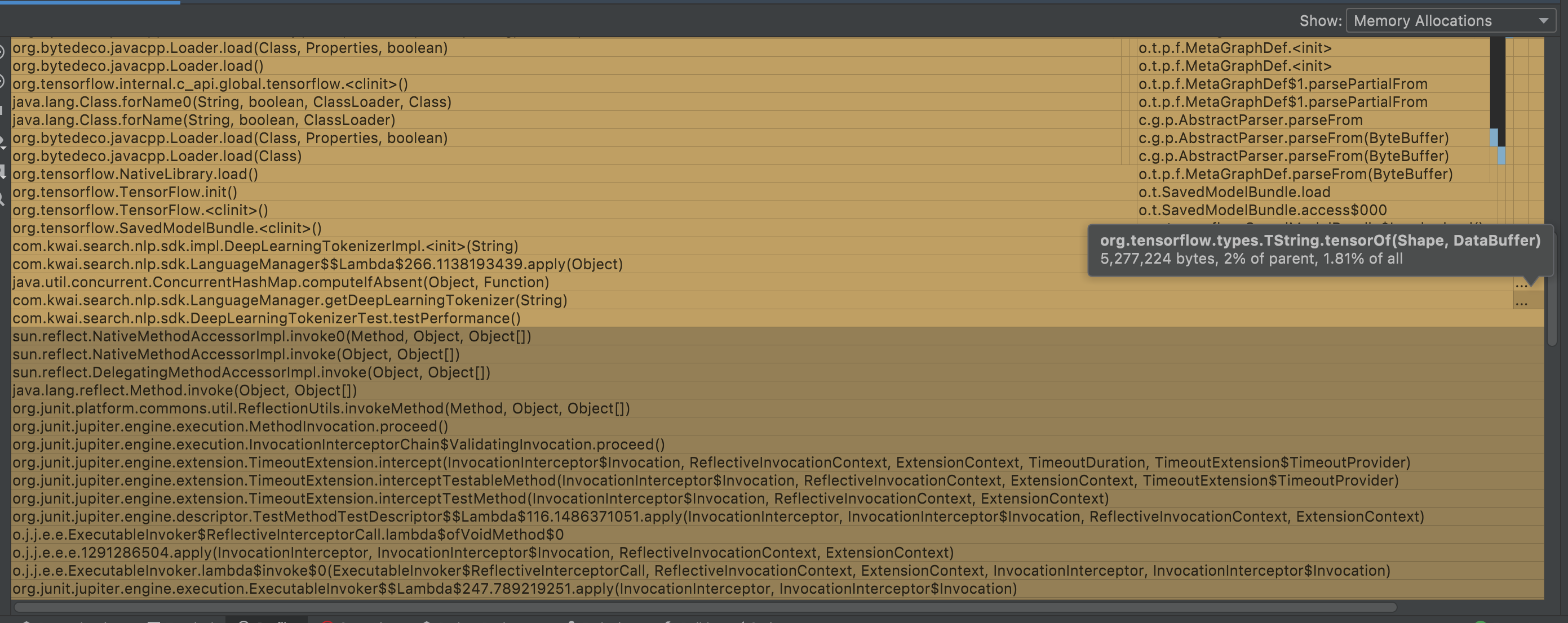
8192 iterations

65536 iterations

The above are IntelliJ IDEA's memory profiling screenshots. The differences are as following:
- The first was recorded when the
forloop runs 4 iterations (; i < 4; ...). TheTString.tensorOfcalls only use 2% memory of its parent call. - The second wass recorded when the
forloop runs 8192 iterations (; i < 8192; ...). TheTString.tensorOfcalls use 49.05% memory of its parent call. - The third was recorded when the
forloop runs 65536 iterations (; i < 65536; ...). TheTString.tensorOfcalls use up to 83.56% memory of its parent call.
Hướng dẫn đóng góp
Bắt đầu từ đâu
- Đọc hết issue, rồi đọc hướng dẫn đóng góp của dự án.
- Bình luận trên issue rằng bạn sẽ nhận — tránh hai người làm cùng một việc.
- Fork repository và làm thay đổi trên một nhánh.
- Mở pull request có tham chiếu số hiệu của issue.
Hướng nghiên cứu
Bắt đầu bằng cách chạy bản tái hiện Java được cung cấp xung quanh TString.tensorOf(Shape, DataBuffer) và DataBuffers.ofObjects(result), sau đó kiểm tra cách TString.close() giải phóng tài nguyên. So sánh hành vi bộ nhớ trong các trường hợp lặp 4, 8192 và 65536 lần. Hoàn thành khi các instance TString được tạo và đóng lặp đi lặp lại không còn khiến mức sử dụng bộ nhớ tăng bất thường.
Do mô hình lập chỉ mục viết ra từ nội dung của issue.
Đánh giá
- Công nghệ
- java
- Lĩnh vực
- machine-learning
- Loại issue
- Lỗi
- Độ khó
- 4/5
- Thời gian dự kiến
- 3-5 ngày
- Mức độ hoạt động
- Đình trệ
- Độ rõ ràng
- Khá rõ ràng
- Mức phù hợp với người mới
- 35/100