Memory leak of TString.tensorOf(Shape shape, DataBuffer<String> data)
Nessuno ha ancora preso questa issue.
- Lingua principale
- Java
- Stelle
- 928
- Fork
- 227
- Metriche di merge delle PR
- Nessuna PR unita negli ultimi 30g
Descrizione
Please make sure that this is a bug. As per our GitHub Policy, we only address code/doc bugs, performance issues, feature requests and build/installation issues on GitHub. tag:bug_template
System information
- Have I written custom code (as opposed to using a stock example script provided in TensorFlow):
Yes - OS Platform and Distribution (e.g., Linux Ubuntu 16.04 x86_64):
macOS 11.5.2 - TensorFlow installed from (source or binary):
Binary - TensorFlow version (use command below):
2.5 - Java version (i.e., the output of
java -version):Java HotSpot(TM) 64-Bit Server VM (build 25.261-b12, mixed mode) - Java command line flags (e.g., GC parameters):
-ea - Python version (if transferring a model trained in Python):
3.7 - Bazel version (if compiling from source): N/A
- GCC/Compiler version (if compiling from source): N/A
- CUDA/cuDNN version: N/A
- GPU model and memory: N/A
- Tensorflow Java version:
0.3.2
Describe the current behavior
When I create and destroy TString instances repeatedly in a for loop, memory usage grows. In my production environment, where a TF model is served by a java service, it would cause memory usage alert after processing certain amount of requests.
Describe the expected behavior
Memory usage should not grow since created TString instances are closed in each iteration.
Code to reproduce the issue
    @Test
    void testPerformance() throws Exception {
        // Some code to load a model but never used it in this test case. Otherwise, the following code would exit randomly. See https://github.com/tensorflow/java/issues/370 .
        final String[] result = new String[] {"a", "b", "c", "d", "e", "f", "g", "h", "i", "c", "c", "c"};
        for (int i = 0; i < 65536; ++i) {
            try (final TString tstring = TString.tensorOf(Shape.of(1, result.length), DataBuffers.ofObjects(result))) {
               // this block is empty.
            }
        }
  }
Other info / logs
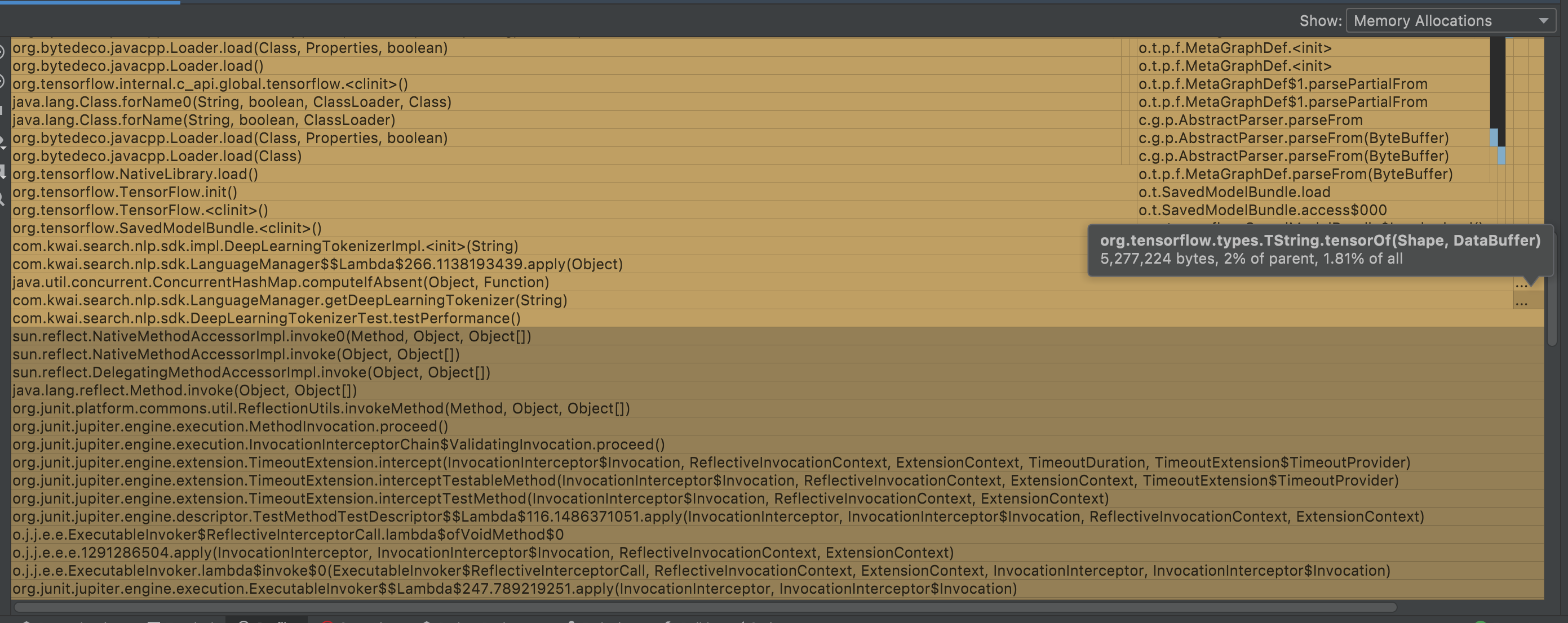
4 iterations
8192 iterations

65536 iterations

The above are IntelliJ IDEA's memory profiling screenshots. The differences are as following:
- The first was recorded when the
forloop runs 4 iterations (; i < 4; ...). TheTString.tensorOfcalls only use 2% memory of its parent call. - The second wass recorded when the
forloop runs 8192 iterations (; i < 8192; ...). TheTString.tensorOfcalls use 49.05% memory of its parent call. - The third was recorded when the
forloop runs 65536 iterations (; i < 65536; ...). TheTString.tensorOfcalls use up to 83.56% memory of its parent call.
Guida per i contributori
Apri la guida per i contributori
Come iniziare
- Leggi tutta la issue e poi la guida ai contributi del progetto.
- Commenta sulla issue per dire che te ne occupi tu — evita che due persone facciano lo stesso lavoro.
- Fai un fork del repository e lavora su un branch.
- Apri una pull request che faccia riferimento al numero della issue.
Direzione di ricerca
Inizia eseguendo la riproduzione Java fornita relativa a TString.tensorOf(Shape, DataBuffer) e DataBuffers.ofObjects(result), quindi esamina come TString.close() rilascia le risorse. Confronta il comportamento della memoria nei casi di 4, 8192 e 65536 iterazioni. Il lavoro è completato quando le istanze di TString create e chiuse ripetutamente non causano più una crescita imprevista dell’utilizzo della memoria.
Scritto dal modello di indicizzazione a partire dal testo della issue.
Valutazione
- Stack tecnologico
- java
- Ambito
- machine-learning
- Tipo di issue
- Bug
- Difficoltà
- 4/5
- Tempo stimato
- 3-5 giorni
- Stato di attività
- Ferma
- Chiarezza
- Abbastanza chiara
- Idoneità per principianti
- 35/100