Memory leak of TString.tensorOf(Shape shape, DataBuffer<String> data)
Personne n'a encore pris cette issue.
- Langage dominant
- Java
- Étoiles
- 928
- Forks
- 227
- Métriques de merge des PR
- Aucune PR mergée en 30 j
Description
Please make sure that this is a bug. As per our GitHub Policy, we only address code/doc bugs, performance issues, feature requests and build/installation issues on GitHub. tag:bug_template
System information
- Have I written custom code (as opposed to using a stock example script provided in TensorFlow):
Yes - OS Platform and Distribution (e.g., Linux Ubuntu 16.04 x86_64):
macOS 11.5.2 - TensorFlow installed from (source or binary):
Binary - TensorFlow version (use command below):
2.5 - Java version (i.e., the output of
java -version):Java HotSpot(TM) 64-Bit Server VM (build 25.261-b12, mixed mode) - Java command line flags (e.g., GC parameters):
-ea - Python version (if transferring a model trained in Python):
3.7 - Bazel version (if compiling from source): N/A
- GCC/Compiler version (if compiling from source): N/A
- CUDA/cuDNN version: N/A
- GPU model and memory: N/A
- Tensorflow Java version:
0.3.2
Describe the current behavior
When I create and destroy TString instances repeatedly in a for loop, memory usage grows. In my production environment, where a TF model is served by a java service, it would cause memory usage alert after processing certain amount of requests.
Describe the expected behavior
Memory usage should not grow since created TString instances are closed in each iteration.
Code to reproduce the issue
    @Test
    void testPerformance() throws Exception {
        // Some code to load a model but never used it in this test case. Otherwise, the following code would exit randomly. See https://github.com/tensorflow/java/issues/370 .
        final String[] result = new String[] {"a", "b", "c", "d", "e", "f", "g", "h", "i", "c", "c", "c"};
        for (int i = 0; i < 65536; ++i) {
            try (final TString tstring = TString.tensorOf(Shape.of(1, result.length), DataBuffers.ofObjects(result))) {
               // this block is empty.
            }
        }
  }
Other info / logs
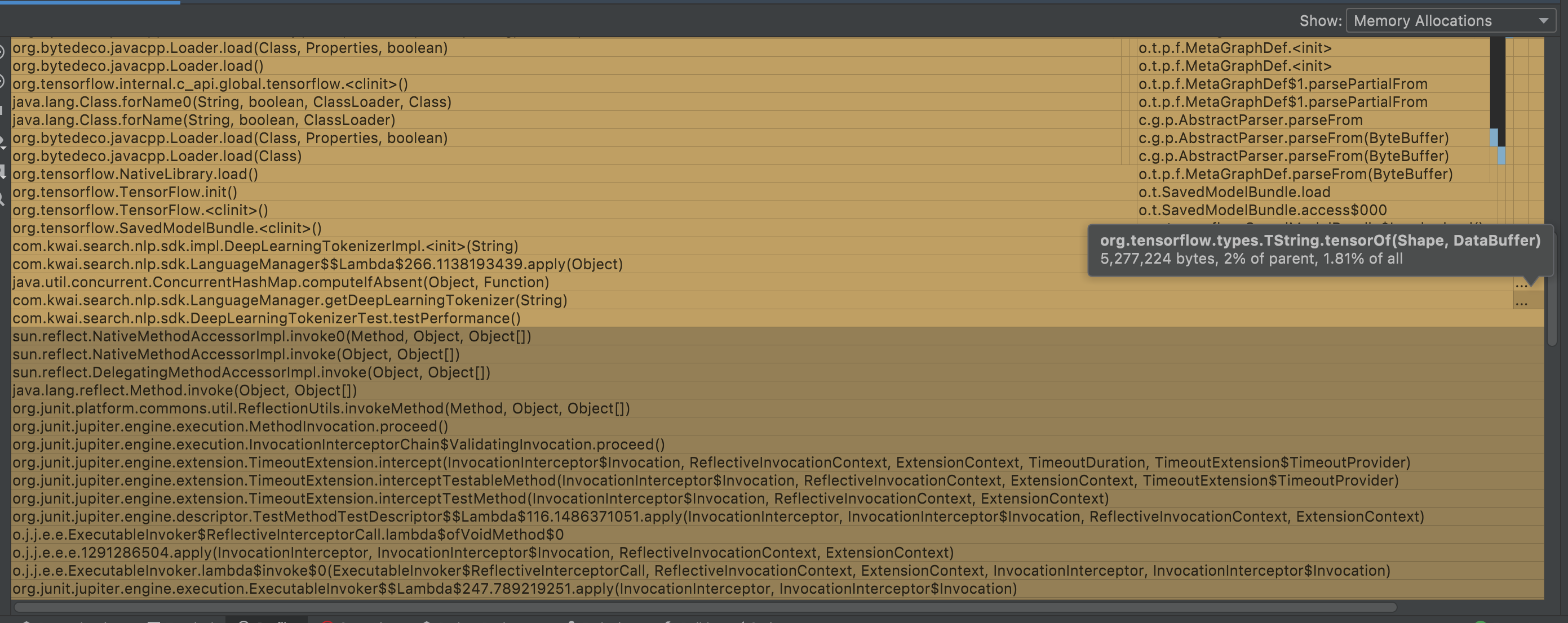
4 iterations
8192 iterations

65536 iterations

The above are IntelliJ IDEA's memory profiling screenshots. The differences are as following:
- The first was recorded when the
forloop runs 4 iterations (; i < 4; ...). TheTString.tensorOfcalls only use 2% memory of its parent call. - The second wass recorded when the
forloop runs 8192 iterations (; i < 8192; ...). TheTString.tensorOfcalls use 49.05% memory of its parent call. - The third was recorded when the
forloop runs 65536 iterations (; i < 65536; ...). TheTString.tensorOfcalls use up to 83.56% memory of its parent call.
Guide de contribution
Ouvrir le guide de contribution
Par où commencer
- Lisez l'issue en entier, puis le guide de contribution du projet.
- Signalez en commentaire que vous la prenez — cela évite que deux personnes fassent le même travail.
- Forkez le dépôt et travaillez sur une branche.
- Ouvrez une pull request qui référence le numéro de l'issue.
Piste de recherche
Commencez par exécuter la reproduction Java fournie autour de TString.tensorOf(Shape, DataBuffer) et de DataBuffers.ofObjects(result), puis examinez comment TString.close() libère les ressources. Comparez le comportement de la mémoire pour les cas de 4, 8192 et 65536 itérations. Le travail est considéré comme terminé lorsque les instances de TString créées et fermées à répétition n’entraînent plus d’augmentation inattendue de l’utilisation mémoire.
Rédigé par le modèle d'indexation à partir du texte de l'issue.
Évaluation
- Stack technique
- java
- Domaine
- machine-learning
- Type d'issue
- Bug
- Difficulté
- 4/5
- Temps estimé
- 3-5 jours
- Activité
- À l'abandon
- Clarté
- Plutôt claire
- Accessibilité débutants
- 35/100