microsoft / microsoft/TypeScript
Symbol definition improvement
Dieses Issue hat noch niemand übernommen.
- Vorherrschende Sprache
- Go
- Sterne
- 111k
- Forks
- 14.3k
- Ø Merge
- 2 T. 4 Std.
- Gemergte PRs (30 T.)
- 132
Beschreibung
Search Terms
symbol in:title, symbol improvement, symbol description definition
Suggestion
By using more and more symbol in my projects, and to make debugging easier in development mode, I fill the optional description to Symbol. Then, on production, I remove all description during the bundling process:
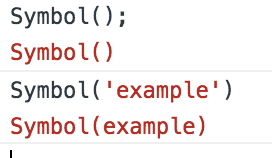
So I was thinking that it could be really useful to have the same approach for TypeScript - playground:
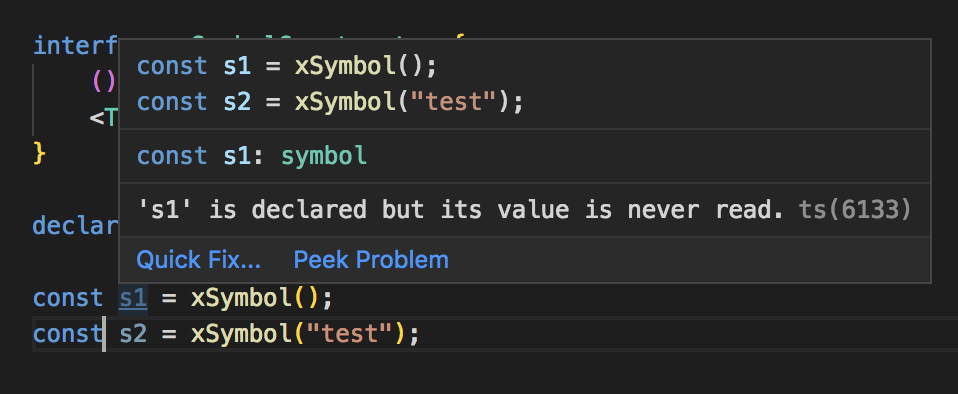
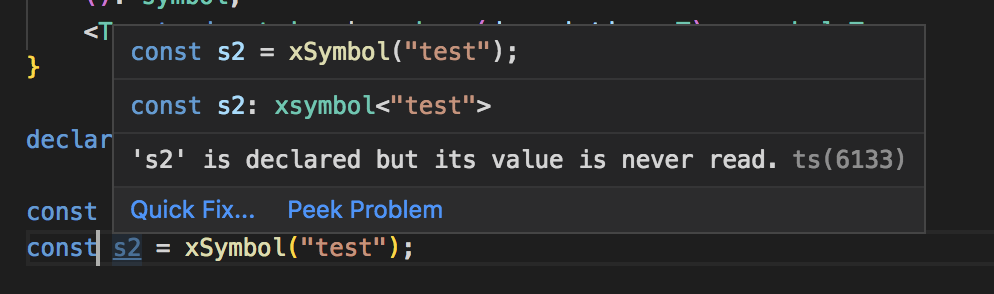
Just imagine we don't have xsymbol<"test"> but the "native" symbol<"test"> or symbol("test") to be closer to DevTools.
Then, by extending this approach, I don't know if it could be helpful to increase the typing inference.
Given this code:
const foo = {
    type: 'foo' as 'foo',
    foo: ''
};

const bar = {
    type: 'bar' as 'bar',
    bar: ''
};

type FooBarAction = typeof foo | typeof bar;

function getType<T>(input: {type: T}): T {
    return input.type;
}

function foobar(action: FooBarAction) {
    switch (action.type) {
        case getType(foo):
            action.foo;
            break;
        case getType(bar):
            action.bar;
            break;
    }
}
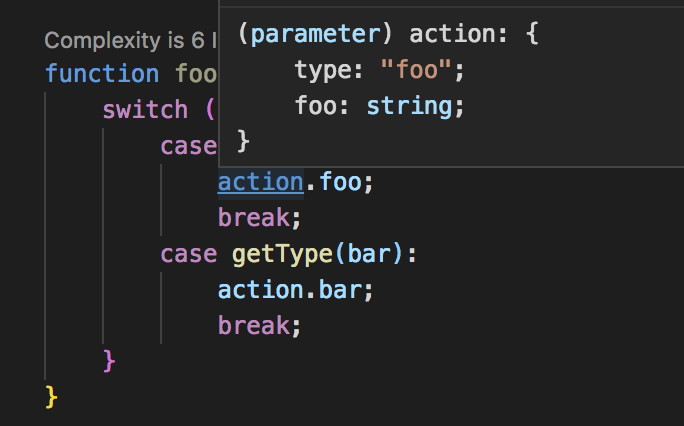
Here, according to the type property value, the action provide correctly foo property or bar property.
But, if I replace them by symbol:
const sFoo = {
    type: Symbol('sfoo'),
    sfoo: ''
};

const sBar = {
    type: Symbol('sbar'),
    sbar: ''
};

type SFooBarAction = typeof sFoo | typeof sBar;

function sfoobar(action: SFooBarAction) {
    switch (action.type) {
        case getType(sFoo):
            action.sfoo;
            break;
        case getType(sBar):
            action.sbar;
            break;
    }
}
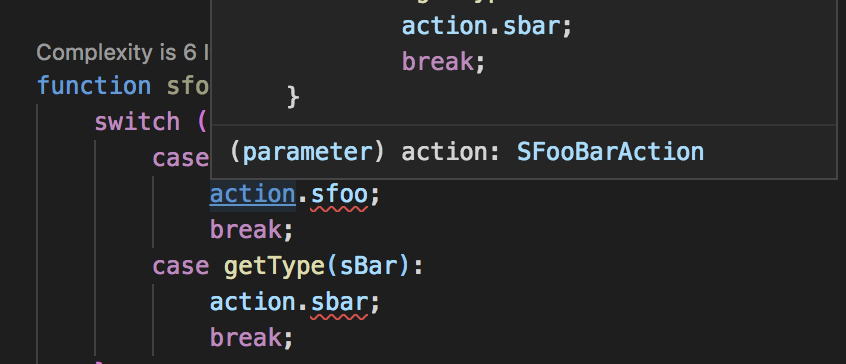

Here TypeScript cannot resolve properly the correct definition of my action variable and keep saying that it get the SFooBarAction type, so only type property is available.
According to this PR #30196, I understand that working on symbol in the core system of TypeScript is not an easy thing, but probably it could be helpful if the optional description of Symbol as a definition descriptor to have the unique symbol in the definition. But definitely, as soon as we provide same description, we will face the same problem as today.
Use Cases
For the first part, everywhere when we use Symbol.
For the second part, as soon as unique value is required, like for Event Emitter, Action in Redux architecture, ...
Examples
See above on the Suggestion section
Checklist
My suggestion meets these guidelines:
- This wouldn't be a breaking change in existing TypeScript/JavaScript code
- This wouldn't change the runtime behavior of existing JavaScript code
- This could be implemented without emitting different JS based on the types of the expressions
- This isn't a runtime feature (e.g. library functionality, non-ECMAScript syntax with JavaScript output, etc.)
- This feature would agree with the rest of TypeScript's Design Goals.
Beitragsleitfaden
Erste Schritte
- Lies das ganze Issue und danach den Beitragsleitfaden des Projekts.
- Schreib ins Issue, dass du es übernimmst — das erspart doppelte Arbeit.
- Forke das Repository und arbeite in einem Branch.
- Öffne einen Pull Request, der die Issue-Nummer nennt.
Rechercherichtung
Beginne damit, die verlinkten TypeScript Playground-Beispiele zu reproduzieren, vergleiche dabei die Fälle mit String-Discriminants mit den Symbol-Fällen und prüfe den zugehörigen PR #30196. Für die Arbeit wäre ein festgelegtes Design für Symbol-Beschreibungen, eindeutige Werte und die Narrowing-Logik des Kontrollflusses erforderlich, zusammen mit dem entsprechenden Compilerverhalten und Tests, die die angeforderte Inferenz demonstrieren.
Vom Indexierungsmodell aus dem Issue-Text verfasst.
Bewertung
- Tech-Stack
- javascript, typescript
- Bereich
- compilers
- Issue-Typ
- Feature
- Schwierigkeit
- 5/5
- Geschätzter Aufwand
- Über eine Woche
- Aktivitätsstatus
- Veraltet
- Klarheit
- Muss geklärt werden
- Anfängerfreundlichkeit
- 25/100