microsoft / microsoft/TypeScript
Add a --strictNaNChecks option, and a NaN / integer / float type to avoid runtime NaN errors
还没有人认领这个 Issue。
- 主要语言
- Go
- 星标
- 111k
- 派生
- 14.3k
- 平均合并
- 2 天 4 小时
- 30 天内合并 PR
- 132
描述
I have read the FAQ and looked for duplicate issues.
Search Terms
- NaN
- NaN type
- Integer type
Related Issues
- #21279: strictNullChecks safeguards against null and undefined, but not NaN
- #15135: NaN, Infinity and -Infinity not accepted in number literal types
- #195: Suggestion: int type
- #4639: Proposal: int types
- BigInt is scheduled for TS 3.0 - #15096 - Support for TC39 "BigInt: Arbitrary precision integers in JavaScript" proposal
Suggestion
NaN has been a big source of errors in my code. I was under the impression that TypeScript (and Flow) could help to prevent these errors, but this is not really true.
TypeScript can prevent some NaN errors, because you cannot add a number to an object, for example. But there are many math operations that can return NaN. These NaN values often propagate through the code silently and crash in some random place that was expecting an integer or a float. It can be extremely difficult to backtrack through the code and try to figure out where the NaN came from.
I would like TypeScript to provide a better way of preventing runtime NaN errors, by ensuring that an unhandled NaN value cannot propagate throughout the code. This would be a compile-time check in TypeScript. Other solutions might be a run-time check added with a Babel plugin, or a way for JS engines to throw an error instead of returning NaN (but these are outside the scope of this issue.)
Use Cases / Examples
const testFunction = (a: number, b: number) => {
  if (a > b) {
    return;
  } else if (a < b) {
    return;
  } else if (a === b) {
    return;
  } else {
    throw new Error("Unreachable code");
  }
}

testFunction(1, 2);

testFunction(1, 0 / 0);

testFunction(1, Math.log(-1));

testFunction(1, Math.sqrt(-2));

testFunction(1, Math.pow(99999999, 99999999));

testFunction(1, parseFloat('string'));
A programmer might assume that the Unreachable code error could never be thrown, because the conditions appear to be exhaustive, and the types of a and b are number. It is very easy to forget that NaN breaks all the rules of comparison and equality checks.
It would be really helpful if TypeScript could warn about the possibility of NaN with a more fine-grained type system, so that the programmer was forced to handle these cases.
Possible Solutions
TypeScript could add a --strictNaNChecks option. To implement this, I think TS might need to add some more fine-grained number types that can be used to exclude NaN. The return types of built-in JavaScript functions and operations would be updated to show which functions can return NaN, and which ones can never return NaN. A call to !isNaN(a) would narrow down the type and remove the possibility of NaN.
Here are some possible types that would make this possible:
type integer
type float
type NaN
type Infinity

type number = integer | float | NaN | Infinity   // Backwards compatible
type realNumber = integer | float   // NaN and Infinity are not valid values
(I don't know if realNumber is a good name, but hopefully it gets the point across.)
Here are some examples of what this new type system might look like:
const testFunction = (a: integer, b: integer) => {
  if (a > b || a < b || a === b) {
    return;
  } else {
    throw new Error("Unreachable code");
  }
}

// Ok
testFunction(1, 2);

// Type error. TypeScript knows that a division might produce a NaN or a float
testFunction(1, 0 / 0);

const a: integer = 1;
const b: integer = 0;

const c = a + b;  // inferred type is `integer`. Adding two integers cannot produce NaN or Infinity.
testFunction(1, c); // Ok

const d = a / b;   // inferred type is `number`, which includes NaN and Infinity.
testFunction(1, d); // Type error (number is not integer)

const e = -2;   // integer
const f = Math.sqrt(e);    // inferred type is: integer | float | NaN    (sqrt of an integer cannot return Infinity)

const g: number = 2;
const h = Math.sqrt(g);    // inferred type is number (sqrt of Infinity is Infinity)

testFunction(1, h);  // Type error. `number` is not compatible with `integer`.

if (!isNaN(h)) {
  // The type of h has been narrowed down to integer | float | Infinity
  testFunction(1, h);  // Still a type error. integer | float | Infinity is not compatible with integer.
}

if (Number.isInteger(h)) {
  // The type of h has been narrowed down to integer
  testFunction(1, h);  // Ok
}
When the --strictNaNChecks option is disabled (default), then the integer and float types would also include NaN and Infinity:
type integer      // Integers plus NaN and Infinity
type float        // Floats plus NaN and Infinity

type number = integer | float    // Backwards compatible
type realNumber = number         // Just an alias, for forwards-compatibility.
I would personally be in favor of making this the default behavior, because NaN errors have caused me a lot of pain in the past. They even made me lose trust in the type system, because I didn't realize that it was still possible to run into them. I would really love to prevent errors like this at compile-time:
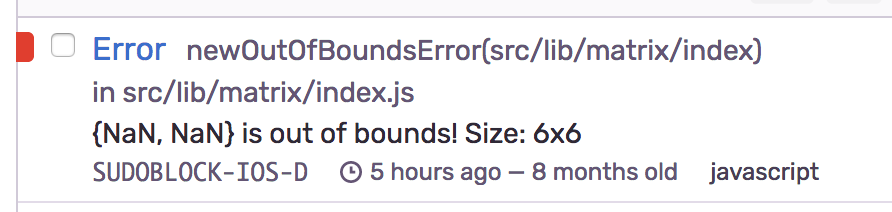
This error is from a fully-typed Flow app, although I'm switching to TypeScript for any future projects. It's one of the very few crashes that I've seen in my app, but I just gave up because I have no idea where it was coming from. I actually thought it was a bug in Flow, but now I understand that type checking didn't protect me against NaN errors. It would be really awesome if it did!
(Sorry for the Flow example, but this is a real-world example where a NaN type check would have saved me a huge amount of time.)
Number Literal Types
It would be annoying if you had to call isNaN() after every division. When the programmer calls a / 2, there is no need to warn about NaN (unless a is a number type that could potentially be NaN.) NaN is only possible for 0 / 0. So if either the dividend or the divisor are non-zero numbers, then the NaN type can be excluded in the return type. And actually zero can be excluded as well, if both dividend and divisor are non-zero.
Maybe this can be done with the Exclude conditional type? Something like:
type nonZeroNumber = Exclude<number, 0>
type nonZeroRealNumber = Exclude<realNumber, 0>
type nonZeroInteger = Exclude<integer, 0>
type nonZeroFloat = Exclude<float, 0>
If the dividend and divisor type both match nonZeroInteger, then the return type would be nonZeroFloat. So you could test any numeric literal types against these non-zero types. e.g.:
const a = 2;     // Type is numeric literal "2"

// "a" matches the "nonZeroInteger" type, so the return type is "nonZeroFloat"
// (this excludes Infinity as well.)
// (Technically it could be "nonZeroInteger", or even "2" if TypeScript did
// constant propagation. But that's way outside the scope of this issue.)
const b = 4 / a;
Checklist
My suggestion meets these guidelines:
- This wouldn't be a breaking change in existing TypeScript/JavaScript code
- This wouldn't change the runtime behavior of existing JavaScript code
- This could be implemented without emitting different JS based on the types of the expressions
- This isn't a runtime feature (e.g. library functionality, non-ECMAScript syntax with JavaScript output, etc.)
- This feature would agree with the rest of TypeScript's Design Goals.
贡献指南
从这里开始
- 先读完整个 Issue,再读项目的贡献指南。
- 在 Issue 下留言说明你要接手 —— 这能避免两个人做同样的事。
- Fork 仓库,在一个分支上完成修改。
- 提交 Pull Request,并在描述里引用这个 Issue 编号。
调研方向
先阅读与 strictNullChecks、NaN 和 Infinity 字面量类型、整数类型以及 BigInt 相关的 issue,然后查看检查清单中链接的 TypeScript Design Goals。当针对拟议的 strictNaNChecks 行为、数值类型、缩小规则和兼容性影响形成一致的设计及相应的实现计划时,这项工作就完成了。
由索引模型根据 Issue 内容生成。
评估
- 技术栈
- javascript, typescript
- 领域
- compilers
- Issue 类型
- 功能
- 难度
- 5/5
- 预计耗时
- 一周以上
- 活跃度
- 停滞
- 描述清晰度
- 基本清楚
- 新手友好度
- 25/100