[Scheduling] Problem understanding `incomingDelay` and `outgoingDelay` in a simple example.
Nobody has claimed this yet.
- Dominant language
- C++
- Stars
- 2.2k
- Forks
- 524
- Avg merge
- 3d 2h
- Merged PRs (30d)
- 46
Description
I'm using the simplex scheduler with a simple example. But I think I misunderstood what the incomingDelay and outgoingDelay are. I understood that the operation must start at least incomingDelay before the next clock tick. After this clock ticks, the results will be available only after outgoingDelay. Am I right?
I have a problem in the following example when I try to schedule it using the simplex scheduler with a cycle-time of 10.0:
ssp.instance of "ChainingCyclicProblem" {
  library {
    operator_type @operator [latency<1>, incDelay<8.0>, outDelay<3.0>]
  }
  graph {
    %0 = operation<@operator> @op0(@op0 [dist<1>])
  }
}
This example represents the following simple circuit :
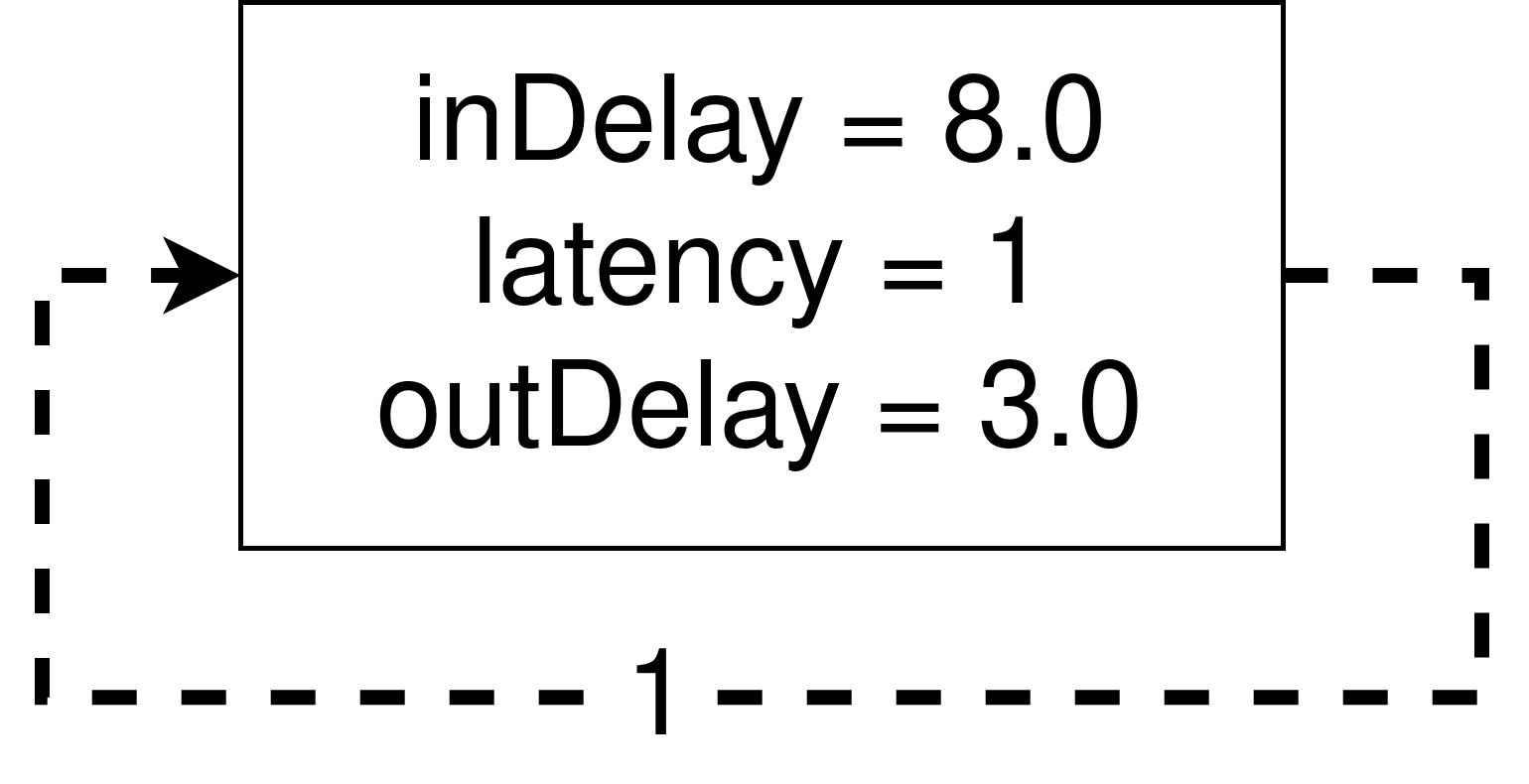
The operation has to start at 8.0 before the end of the cycle, and the results are available after 3.0 in the next cycle. Having II=1 is impossible as the operation needs the results of its previous iteration. Leads to the following schedule, with II=2 :
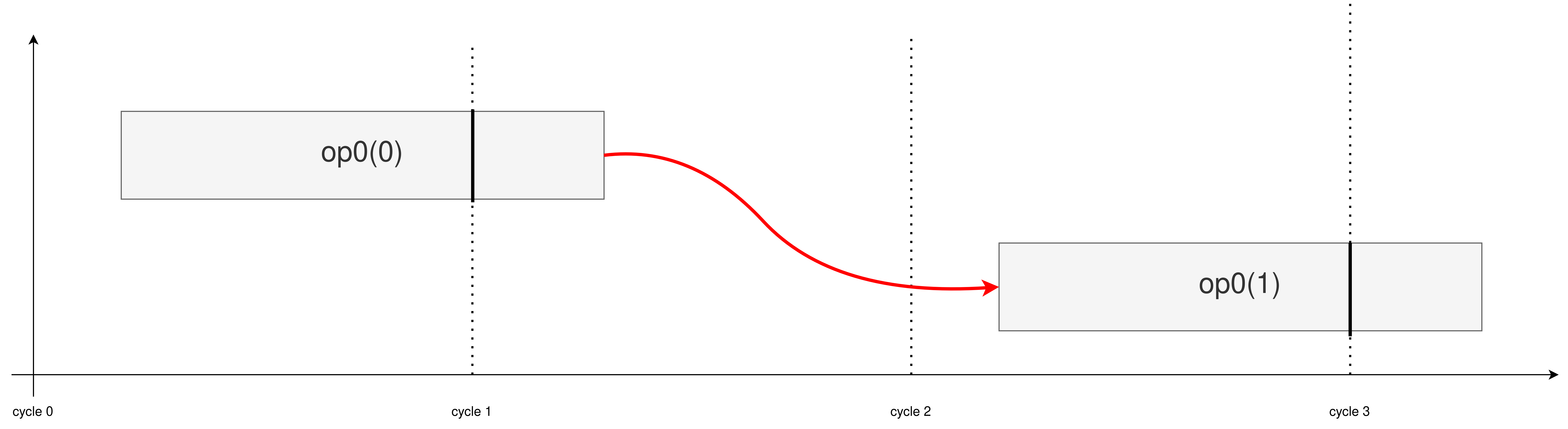
But when I use circt-opt with the argument -ssp-schedule="scheduler=simplex options=cycle-time=10.0" the result is :
ssp.instance of "ChainingCyclicProblem" [II<1>] {
  library {
    operator_type @operator [latency<1>, incDelay<8.000000e+00 : f32>, outDelay<3.000000e+00 : f32>]
  }
  graph {
    %0 = operation<@operator> @op0(@op0 [dist<1>]) [t<0>, z<0.000000e+00 : f32>]
  }
}
This means the schedule would look like this:
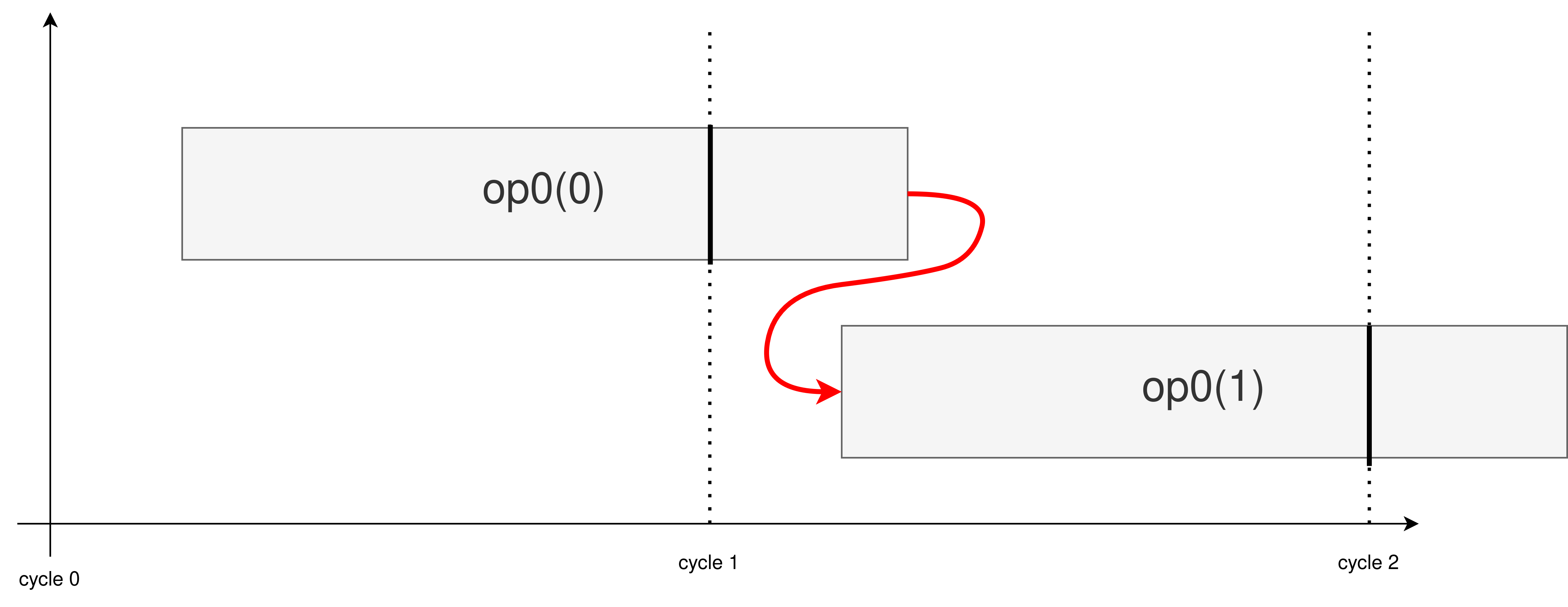
How is this schedule correct? What did I miss about circt's scheduling problems?
Contributor guide
No contributing guide indexed for this repository
First steps
- Read the whole issue, then the project's contributing guide.
- Comment on the issue to say you are picking it up — it saves two people doing the same work.
- Fork the repository and make your change on a branch.
- Open a pull request that references the issue number.
Research direction
Start with the simplex scheduler and the circt-opt invocation using scheduler=simplex options=cycle-time=10.0; inspect how incomingDelay, outgoingDelay, and the reported II are interpreted. Compare the example's expected II=2 with the emitted II=1 schedule, and document whether the schedule is valid and what the delay semantics mean.
Written by the indexing model from the issue text.
Assessment
- Tech stack
- cpp
- Domain
- compilers
- Issue type
- Documentation
- Difficulty
- 4/5
- Estimated time
- 3-5 days
- Activity status
- Stale
- Clarity
- Mostly clear
- Newbie friendliness
- 35/100