aai-institute / aai-institute/pyDVL
Implement Projected Stochastic Gradient Shapley
- Dominant language
- Python
- Stars
- 146
- Forks
- 10
- PR merge metrics
- No merged PRs in 30d
Description
As introduced in _Simon, Grah, and Thouvenot Vincent. ‘A Projected Stochastic Gradient Algorithm for Estimating Shapley Value Applied in Attribute Importance’. In Machine Learning and Knowledge Extraction, edited by Andreas Holzinger, Peter Kieseberg, A Min Tjoa, and Edgar Weippl, 12279:97–115. Lecture Notes in Computer Science. Cham: Springer International Publishing, 2020. https://doi.org/10.1007/978-3-030-57321-8_6._
Code available [here](https://github.com/ThalesGroup/shapkit)
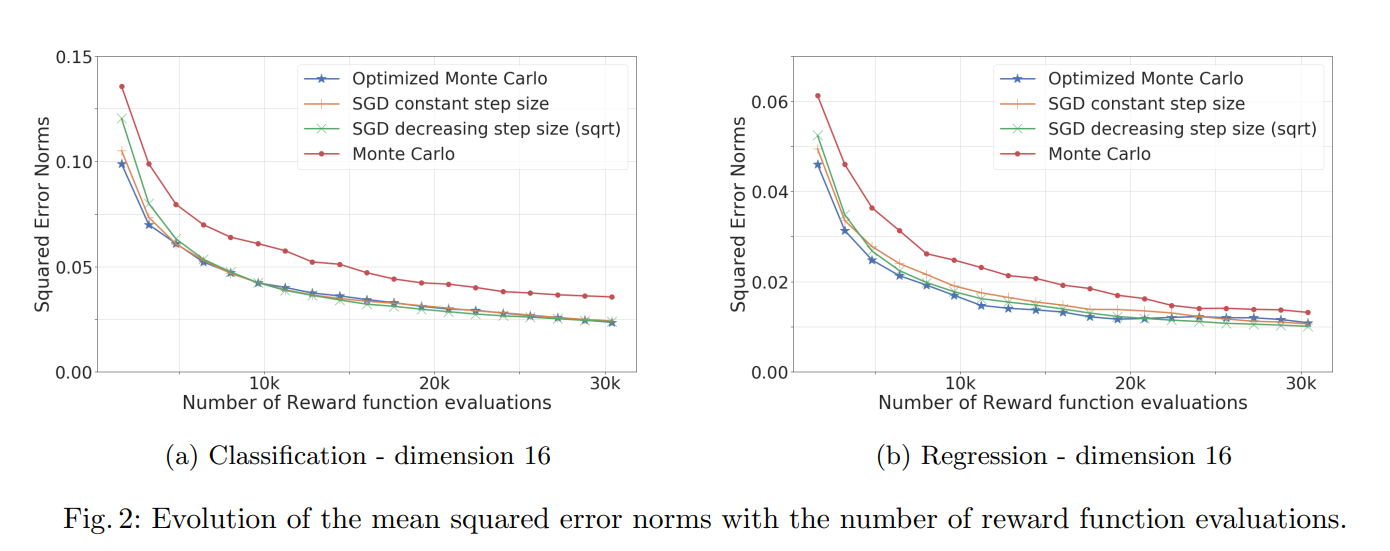
The paper focuses on feature valuation, but it's just another approximation for Shapley Values based on convex optimization. It's also roughly on-par with Monte Carlo and sometimes worse, so maybe not so important. But may be worth checking.
Contributor guide
Research direction
Read the linked paper and examine the reference implementation in the ThalesGroup/shapkit repository. Understand the projected stochastic gradient algorithm for Shapley value approximation. Identify where in pyDVL's codebase new approximation methods are added, likely in a module like `pydvl.value.shapley`. Implement the algorithm, ensuring it integrates with the existing API for data valuation. Write tests to compare its performance against Monte Carlo methods.
Written by the indexing model from the issue text.
Assessment
- Tech stack
- python
- Domain
- ai, machine-learning
- Issue type
- Feature
- Difficulty
- 5/5
- Estimated time
- Over a week
- Activity status
- Stale
- Clarity
- Mostly clear
- Newbie friendliness
- 20/100