InnerSourceCommons / InnerSourceCommons/InnerSourcePatterns
Pattern idea: Operational Model for InnerSource
Nadie ha tomado este issue todavía.
- Lenguaje dominante
- HTML
- Estrellas
- 853
- Forks
- 206
- Merge medio
- 1 d 23 h
- PR fusionados (30 d)
- 2
Descripción
This issue opens the discussion about the need for an InnerSource operational model. This is based on past authors experiences.
The following is a draft of the pattern to move this forward as a PR.
InnerSource Operational Model
Title
InnerSource Operational Model
Patlet
InnerSource is key across all of the software production chain. This includes from idea to delivery to customer. This pattern defines the software development life cycle from an InnerSource perspective.
Problem
InnerSource is typically focused on letting developers work together. There are several patterns focused on specific roles as the Trusted Committer or from a more organization level as the Review Committee. However, it is still not clear how all of this works together.
This pattern aims at providing an overview to management and Chief level of how the software life cycle may be in a more InnerSource way with the goal of having a place where InnerSource principles may apply to the several people involved: from Product Owners to Contributors.
This may be seen as well as the glue for other patterns willing to make sense from a development lifecycle perspective.
Story (optional)
Context
The content here is often tied to the applicability of the pattern for other readers: "Do I have this same particular situation?"
The problem initially exists at the management level where the several business units are defining their needs, tuning the product, and suggesting next steps. A general overview of this process and key moments in the chain where they can influence (e.g., POs discussions) are part of this.
Forces
As the software production chain involves roles with different goals, this way of working has to be part of everyone involved. Business related people as Product Owners may be reluctant to move into a more collaborative and transparent way of producing software. And this may happen with others as well.
Sketch (optional)
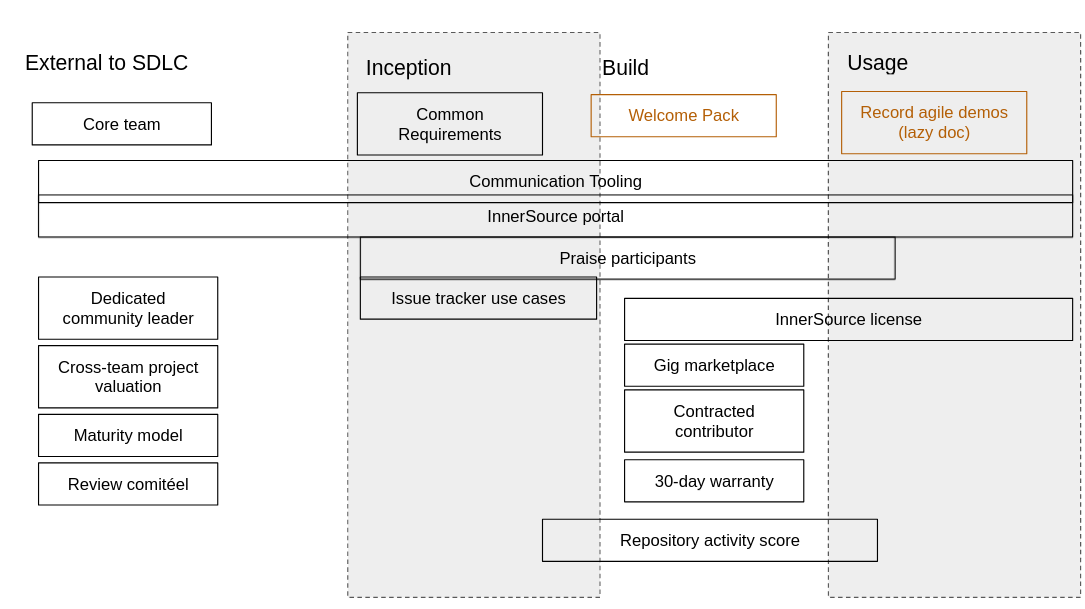
The following is an example of a tentative pattern solution related to this. Existing patterns are now part of this discussion for the software development life cycle.
Solutions
The proposed solution is a simplified version of a Software Development Lifecycle. This pattern works on three main areas for the software development life cycle that are:
a) Inception where the idea is discussed and specified (e.g., as user story),
b) Build where the developer collaboration takes place with other developers, where the user story is translated into code, and
c) usage as the moment in time the software is producing value at the final end users even in other business units or departments.
These three main areas should at the same time comply with the InnerSource principles (transparency, collaboration, community, etc.).
Resulting Context
The resulting context is that the corporation has defined and is using an operational model to work in a more transparent and collaborative way. This model can be later extended to other projects within the corporation.
This model is useful as well to compare to other existing models in the company, and check how InnerSource this is. For further reference please check the Maturity Model Pattern.
If applied, this model brings more transparency to any of the decision making process at the company, and it is clear to others the end-to-end process to build software.
Rationale (optional)
Known Instances (optional)
Status (optional until merging)
Initial status, opening discussion.
Author(s) (optional)
Igor Zubiaurre
Daniel Izquierdo Cortázar
Acknowledgements (optional)
Alias (optional)
Guía de contribución
Primeros pasos
- Lee el issue completo y luego la guía de contribución del proyecto.
- Comenta en el issue que vas a ocuparte — evita que dos personas hagan lo mismo.
- Haz un fork del repositorio y trabaja en una rama.
- Abre un pull request que haga referencia al número del issue.
Línea de trabajo
No se menciona ningún archivo ni prueba del repositorio; empieza revisando las secciones del borrador en este issue y el esquema vinculado de Operational Model. Revisa los patrones existentes y el Maturity Model Pattern para obtener contexto y, después, determina si el borrador está lo suficientemente completo y consensuado como para avanzar como pull request.
Escrito por el modelo de indexación a partir del texto del issue.
Evaluación
- Área
- documentation
- Tipo de issue
- Documentación
- Dificultad
- 5/5
- Tiempo estimado
- Más de una semana
- Estado de actividad
- Estancado
- Claridad
- Necesita aclaración
- Aptitud para principiantes
- 25/100