typesense / typesense/typesense
Feature Request: Binomial Coefficient Entropy Coding for Inverted Index Postings
Nobody has claimed this yet.
- Dominant language
- C++
- Stars
- 26.6k
- Forks
- 973
- Avg merge
- 18h 45m
- Merged PRs (30d)
- 4
Description
- Feature Name: Binomial Coefficient Entropy Coding for Inverted Index Postings
- Status: draft
- Start Date: 2021-12-13
- Authors: Murage Kibicho
Summary
This is a proposal for encoding inverted index integer sequences using a number system based on binomial coefficients.
This number system is chosen because the minimum number of bits needed to encode a list of strictly increasing integers
is given by the equation 
where  is largest number in the list and
  is the number of elements in the list.
For example to encode the sequence 1,2,3,4,10,11 we need at least 9 bits:  and
and
 .
.
Binary interpolative coding, one of the best methods for inverted list compression takes at least 20 bits to represent the example sequence. You can confirm this here.
However, if we represent the same sequence as a sum of binomial coefficients, it takes 10 bits to encode the list, and an extra 3 bits to store the length of the list. The total is 13 bits. You can confirm this here.
Motivation
Compression is a solved problem. The best compressors work by changing radixes, or number bases to find the most concise representation of data.
For instance, arithmetic coding is a generalized change of radix for coding
at the information theoretic entropy bound. This bound is a measure of redundancy - how many duplicates are in your data. Strictly increasing integer sequences have no duplicates, therefore, cannot be compressed
according to the information theoretic bound. This means huffman coding and arithmetic coding methods are inefficient with non-repetitive integer sequences.
This rfc proposes the use of the combinatorial number system to encode inverted index integer sequences at the combinatorial information theoretic entropy bound.
Just like arithmetic coding, this change in number systems allows us to encode integer sequences with the least number of bits.
I am a Math major in my junior year and if this RFC succeeds I would love to take a gap year and work on this library full time. The library
has sample code for converting between binary and the combinatorial number system using a greedy algorithm, or by generating a lookup table.
Technical design
Overview of Combinatorial Number System
Any natural number  can be uniquely written as a sum of binomial coefficients
using this greedy algorithm.
- Find the largest binomial coefficient such that

- Subtract to find the residue

- Find the largest binomial coefficient such that

Example: Find the combinatorial representation of 

To reverse the process, sum your list of binomial coefficients

Comparison to Binary Interpolative Coding
In the example above, it can be seen that the sequence 
can be encoded in  using the combinatorial number system with an extra 3 bits to store the length of the sequence. This is a total of 9 bits to encode this sequence.
Using this library it can be confirmed that binary interpolative coding takes between 15 to 23 bits to encode the same sequence.
This is a screenshot of the result of binary interpolative coding.
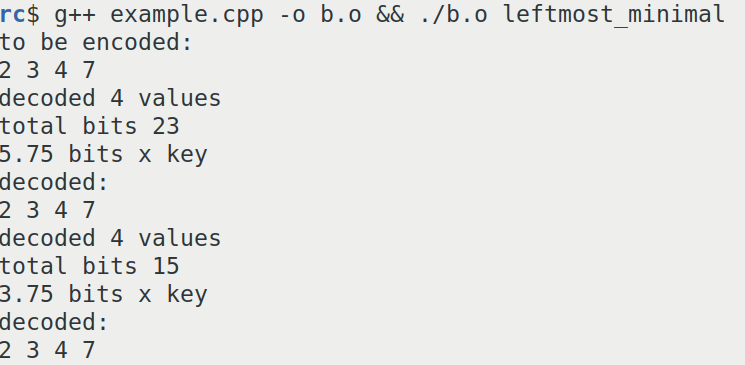
The combinatorial number systems always encodes integer sequences at the entropy limit.
Contributor guide
First steps
- Read the whole issue, then the project's contributing guide.
- Comment on the issue to say you are picking it up — it saves two people doing the same work.
- Fork the repository and make your change on a branch.
- Open a pull request that references the issue number.
Research direction
Start by reading this RFC and the linked MathLibraries sample code, then review the linked combinatorial-coding references and comparison with binary interpolative coding. The issue names no Typesense file, test, or entry point, and completion criteria for integrating the proposed encoding into inverted index postings are not defined.
Written by the indexing model from the issue text.
Assessment
- Tech stack
- cpp
- Domain
- search
- Issue type
- Feature
- Difficulty
- 5/5
- Estimated time
- Over a week
- Activity status
- Stale
- Clarity
- Needs clarification
- Newbie friendliness
- 25/100