typelevel / typelevel/cats-effect
Different exception handling on the work stealing runtime compared to a fixed thread executor
Nobody has claimed this yet.
- Dominant language
- Scala
- Stars
- 2.2k
- Forks
- 576
- Avg merge
- 2d 11h
- Merged PRs (30d)
- 18
Description
The work stealing runtime is safer when it comes to handling exceptions through running Runnables through EC#execute than when using a different Executor. Throwing exceptions on the worker threads of a fixed thread pool results in the death of those threads, and depending on the configuration of the ThreadFactory, those same threads may or may not be replaced by new ones. Furthermore, throwing fatal exceptions in a Runnable on any other thread pool will not currently result in a graceful shutdown of an IOApp, because we have bespoke logic to handle this as part of the IOFiber runloop. Currently, this safety comes at a performance disadvantage for the work stealing runtime by having to suspend every submitted runnable in an IO.delay. I think I have a way of equalizing the exception handling between the work stealing thread pool and any other thread pool used as a compute pool for IO and improving the performance of the work stealing runtime as a normal execution context for running Runnables, but this essentially comes at a performance cost of other ExecutionContexts used as a compute pool.
Here is a sample application with a fixed thread pool that shows this behavior:
package cats.effect
package example

import cats.effect.unsafe.IORuntime

object Example extends IOApp.Simple {

  override def runtime: IORuntime = {
    import java.util.concurrent.atomic.AtomicInteger
    import java.util.concurrent.Executors
    import cats.effect.unsafe.IORuntimeConfig
    import cats.effect.unsafe.Scheduler
    import scala.concurrent.ExecutionContext

    val (blocking, blockDown) = {
      val threadCount = new AtomicInteger(0)
      val executor = Executors.newCachedThreadPool { (r: Runnable) =>
        val t = new Thread(r)
        t.setName(s"io-blocking-${threadCount.getAndIncrement()}")
        t.setDaemon(true)
        t
      }
      (ExecutionContext.fromExecutor(executor), () => executor.shutdown())
    }

    val (scheduler, schedDown) = {
      val executor = Executors.newSingleThreadScheduledExecutor { r =>
        val t = new Thread(r)
        t.setName("io-scheduler")
        t.setDaemon(true)
        t.setPriority(Thread.MAX_PRIORITY)
        t
      }
      (Scheduler.fromScheduledExecutor(executor), () => executor.shutdown())
    }

    val (compute, compDown) = {
      val threadCount = new AtomicInteger(0)
      val executor = Executors.newFixedThreadPool(
        8,
        { r =>
          if (threadCount.get() >= 8) null
          else {
            val t = new Thread(r)
            t.setName(s"io-compute-${threadCount.getAndIncrement()}")
            t.setDaemon(true)
            t
          }
        })
      (ExecutionContext.fromExecutor(executor), () => executor.shutdown())
    }

    val cancelationCheckThreshold =
      System.getProperty("cats.effect.cancelation.check.threshold", "512").toInt

    new IORuntime(
      compute,
      blocking,
      scheduler,
      () => {
        compDown()
        blockDown()
        schedDown()
      },
      IORuntimeConfig(
        cancelationCheckThreshold,
        System
          .getProperty("cats.effect.auto.yield.threshold.multiplier", "2")
          .toInt * cancelationCheckThreshold
      )
    )
  }

  def run: IO[Unit] =
    IO.executionContext.flatMap { ec =>
      IO {
        for (_ <- 0 until 20) {
          ec.execute(() => throw new RuntimeException("Boom!"))
        }
      }
    } *> IO.never[Unit]
}
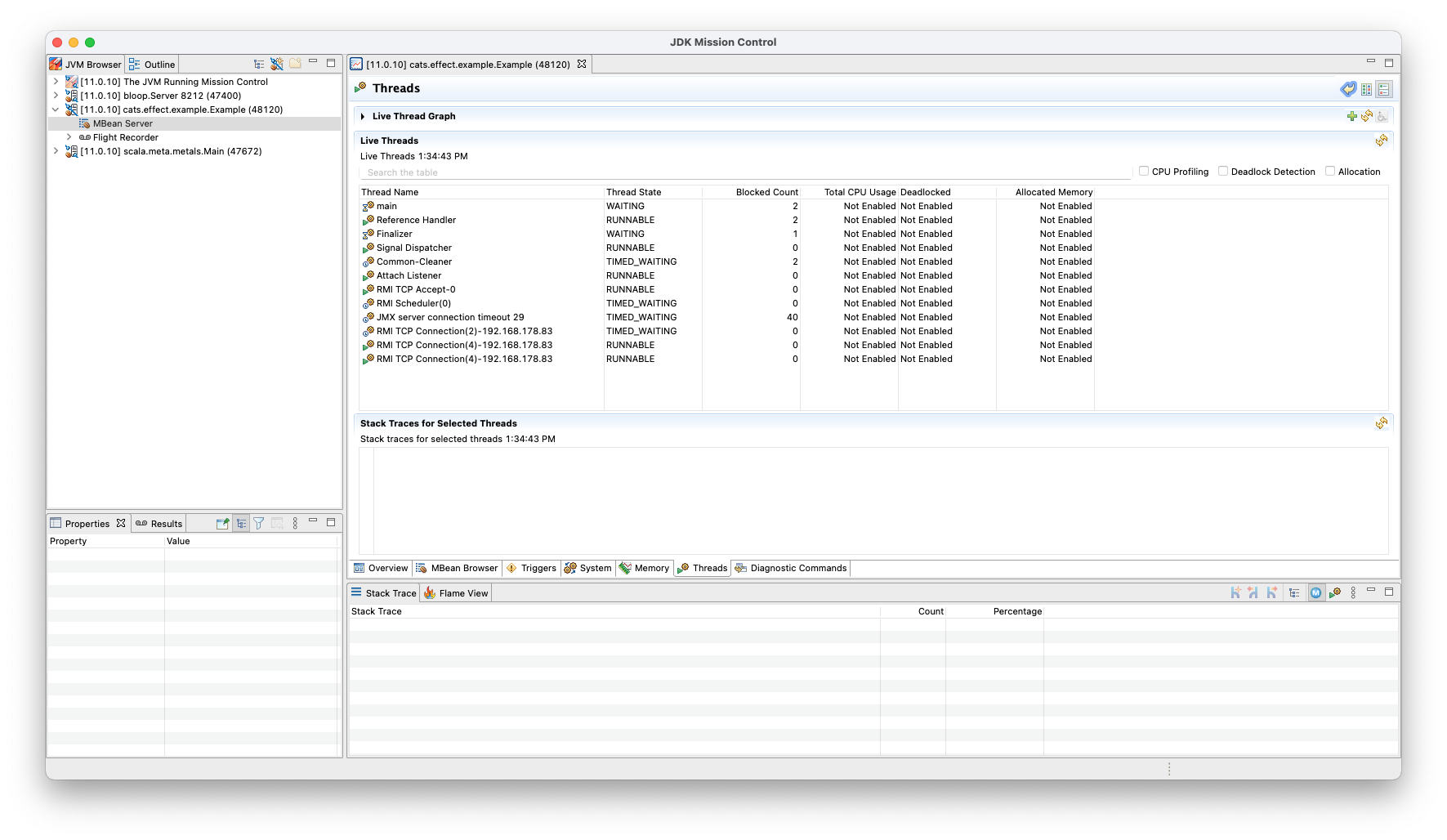
Executing this application results in the following situation in JDK Misssion Control where all io-compute threads are dead:
Contributor guide
First steps
- Read the whole issue, then the project's contributing guide.
- Comment on the issue to say you are picking it up — it saves two people doing the same work.
- Fork the repository and make your change on a branch.
- Open a pull request that references the issue number.
Research direction
Start with the work-stealing runtime, EC#execute, IOFiber's runloop, and IORuntime's compute ExecutionContext; the issue names no files or tests. Reproduce the fixed-thread-pool behavior from the supplied IOApp example, then compare exception handling and performance across the two executor types. Done requires consistent fatal-exception behavior without the current work-stealing performance disadvantage.
Written by the indexing model from the issue text.
Assessment
- Tech stack
- java, scala
- Domain
- backend
- Issue type
- Bug
- Difficulty
- 5/5
- Estimated time
- Over a week
- Activity status
- Stale
- Clarity
- Needs clarification
- Newbie friendliness
- 25/100