tensorflow / tensorflow/recommenders
Validation loss increasing but validation metric is improving
Nobody has claimed this yet.
- Dominant language
- Python
- Stars
- 2k
- Forks
- 300
- PR merge metrics
- No merged PRs in 30d
Description
I have trained a deep retrieval model for my own data (~3 million records) and I have trained 30 epochs.
I have seen that the "val_loss "decrease over the first few epochs and it is increasing afterwards while "train_loss" is decreasing all the time. However the 'val_factorized_top_k/top_k_categorical_accuracy' is improving over time.
Here are the history I got from the training
'val_loss': [8014.77734375,
 7885.28125,
 7907.8330078125,
 7969.4365234375,
 8067.931640625,
 8149.6533203125,
 8244.7119140625,
 8333.19921875,
 8430.1044921875,
 8520.3896484375,
 8618.4736328125,
 8707.265625,
 8793.5078125,
 8870.9580078125,
 8948.453125,
 9021.32421875,
 9098.4072265625,
 9163.1103515625,
 9231.8291015625,
 9284.50390625,
 9345.865234375,
 9403.099609375,
 9460.916015625,
 9509.5234375,
 9557.9970703125,
 9608.4462890625,
 9654.29296875,
 9700.2646484375,
 9740.9912109375,
 9786.341796875],
'val_factorized_top_k/top_100_categorical_accuracy': [0.02200424112379551,
 0.02866148203611374,
 0.03169553354382515,
 0.0347590446472168,
 0.0349946990609169,
 0.03891245275735855,
 0.03905973955988884,
 0.04182868078351021,
 0.0411217138171196,
 0.04427359625697136,
 0.043596088886260986,
 0.04586426168680191,
 0.04568752273917198,
 0.0474843867123127,
 0.04692470654845238,
 0.049428537487983704,
 0.048957228660583496,
 0.050135500729084015,
 0.04992930218577385,
 0.051431600004434586,
 0.050695180892944336,
 0.052020736038684845,
 0.05146105960011482,
 0.05234476178884506,
 0.05199128016829491,
 0.05311064049601555,
 0.052374217659235,
 0.053611405193805695,
 0.05328737944364548,
 0.05449511110782623],
Also here is the screenshot I got from the tensorboard.
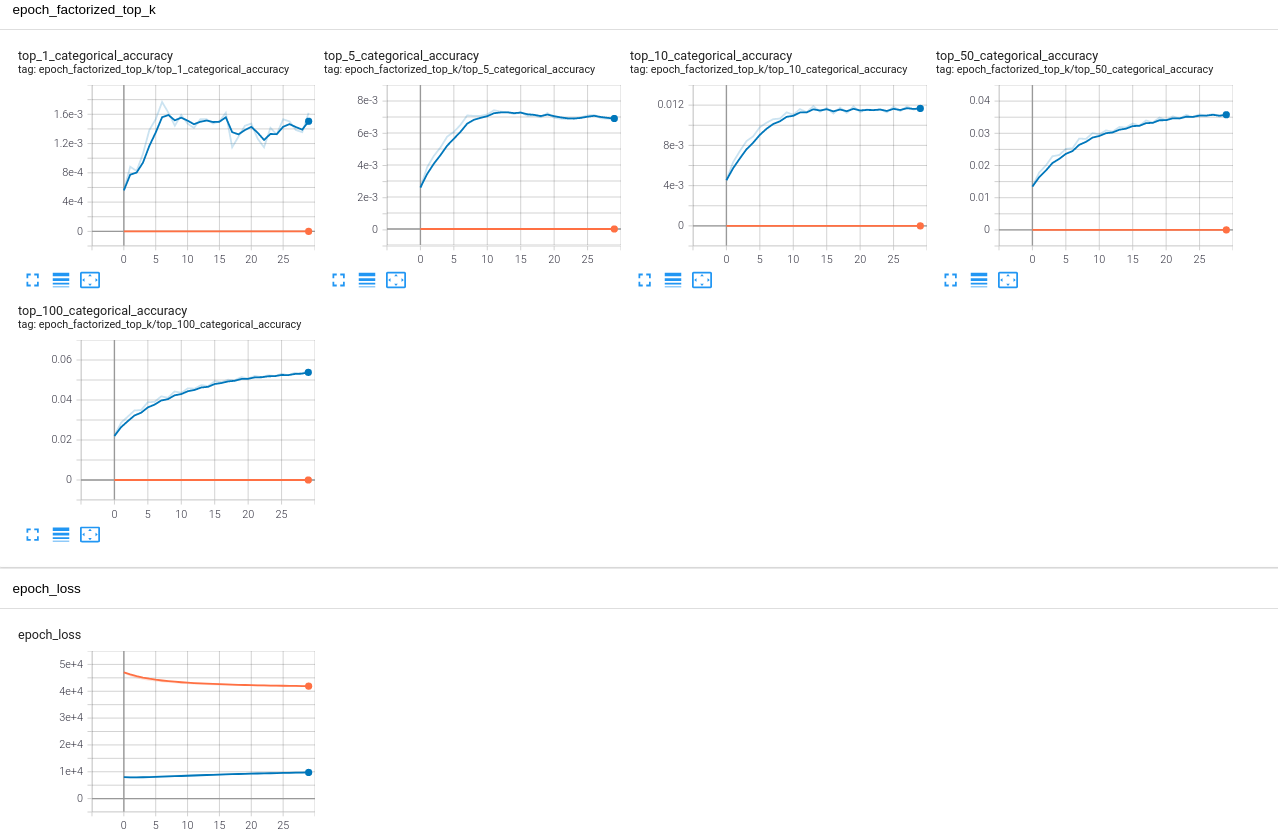
Is there any good explanation why that is the case? I am quite confused here.
Contributor guide
First steps
- Read the whole issue, then the project's contributing guide.
- Comment on the issue to say you are picking it up — it saves two people doing the same work.
- Fork the repository and make your change on a branch.
- Open a pull request that references the issue number.
Research direction
No files, tests, or entry points are named in the issue. Start by reviewing the training configuration and definitions of the reported validation loss and factorized top-k metric, then compare their behavior against the supplied history. Done would be a project-specific explanation of whether the differing trends are expected or indicate a defect.
Written by the indexing model from the issue text.
Assessment
- Tech stack
- python, tensorflow
- Domain
- machine-learning
- Issue type
- Bug
- Difficulty
- 4/5
- Estimated time
- 3-5 days
- Activity status
- Stale
- Clarity
- Needs clarification
- Newbie friendliness
- 25/100