Survival models with time-varying specification: the first covariate will be modeled as time-varying variable
Nobody has claimed this yet.
- Dominant language
- R
- Stars
- 401
- Forks
- 136
- PR merge metrics
- No merged PRs in 30d
Description
Summary:
Time-varying covariate specification seems to always apply to the first covariate in the model.
Description:
model:
mod = survival object ~ p2 + p3 + tve(p1)
p2 is modelled as a time-varying covariate.
However, changing covariate order will fix the problem.
mod2 = survival object ~ tve(p1) + p2 + p3
Thus, it seems that tve()-specified covariates always have to the first in the model.
Reproducible Steps:
#data, its size reduzing and standardization of 2 variables
library(tidyverse)
df = read_delim("https://www.dropbox.com/s/ufpmejd6do8saq6/shared_data.csv?dl=1", ";", escape_double = FALSE, trim_ws = TRUE) %>% mutate(p3 = scale(p3), p4 = scale(p4)) %>%  group_by(p1) %>% sample_n(50)
This model specification seems to work as supposed to.
library(rstanarm)
options(mc.cores = parallel::detectCores())
#model 1
m1 = stan_surv(Surv(time, status) ~ tve(p1) + p3 + p4, df)
m1
stan_surv
 baseline hazard: M-splines on hazard scale
 formula:         Surv(time, status) ~ tve(p1) + p3 + p4
 observations:    100
 events:          45 (45%)
 right censored:  55 (55%)
 delayed entry:   no
------

                 Median MAD_SD exp(Median)
(Intercept)      -0.6    0.2     NA
**p1B               0.2    0.4    1.2**
p3                0.6    0.2    1.8
p4                0.3    0.1    1.4
**p1B:tve-bs-coef1 -0.3    0.7    0.7
p1B:tve-bs-coef2 -0.5    0.7    0.6
p1B:tve-bs-coef3 -0.6    0.8    0.6**
smooth_sd[p1B]    0.5    0.5    1.7
m-splines-coef1   0.1    0.0     NA
m-splines-coef2   0.2    0.1     NA
m-splines-coef3   0.2    0.1     NA
m-splines-coef4   0.2    0.1     NA
m-splines-coef5   0.1    0.1     NA
m-splines-coef6   0.1    0.1     NA

------
* For help interpreting the printed output see ?print.stanreg
* For info on the priors used see ?prior_summary.stanreg
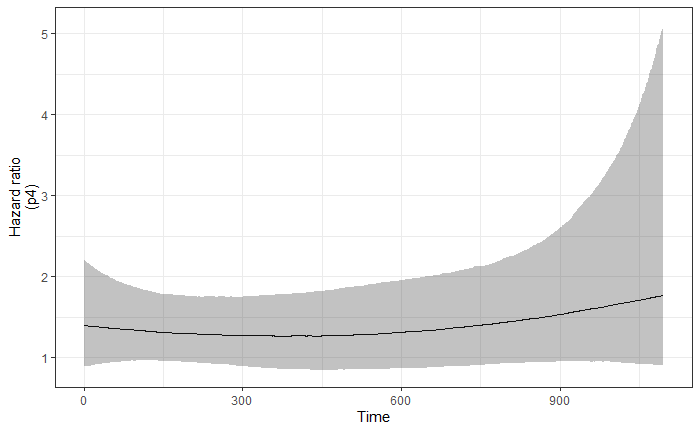
This models the first covariate p4 as time-varying.
#model 2
m2 = stan_surv(Surv(time, status) ~ p4 + p3 + tve(p1), df)
m2
There were 5 divergent transitions after warmup. See
https://mc-stan.org/misc/warnings.html#divergent-transitions-after-warmup
to find out why this is a problem and how to eliminate them.Examine the pairs() plot to diagnose sampling problems
stan_surv
 baseline hazard: M-splines on hazard scale
 formula:         Surv(time, status) ~ p4 + p3 + tve(p1)
 observations:    100
 events:          45 (45%)
 right censored:  55 (55%)
 delayed entry:   no
------
                Median MAD_SD exp(Median)
(Intercept)     -0.7    0.2     NA
**p4               0.3    0.2    1.4**
p3               0.6    0.2    1.8
p1B              0.0    0.3    1.0
**p4:tve-bs-coef1 -0.2    0.5    0.8
p4:tve-bs-coef2 -0.1    0.5    0.9
p4:tve-bs-coef3  0.3    0.5    1.3**
smooth_sd[p4]    0.5    0.5    1.7
m-splines-coef1  0.1    0.0     NA
m-splines-coef2  0.2    0.1     NA
m-splines-coef3  0.2    0.1     NA
m-splines-coef4  0.2    0.1     NA
m-splines-coef5  0.1    0.1     NA
m-splines-coef6  0.1    0.1     NA

------
* For help interpreting the printed output see ?print.stanreg
* For info on the priors used see ?prior_summary.stanreg
tve plot for the first covariate p4
m2 %>% plot(, plotfun = "tve", pars = "p4")
RStanARM Version:
‘2.21.2’
R Version:
‘4.0.4’
Operating System:
Windows 10 Enterprise, 21H1, 19043.985, Windows Feature Experience Pack 120.2212.2020.0
Contributor guide
No contributing guide indexed for this repository
First steps
- Read the whole issue, then the project's contributing guide.
- Comment on the issue to say you are picking it up — it saves two people doing the same work.
- Fork the repository and make your change on a branch.
- Open a pull request that references the issue number.
Research direction
Start by reproducing the two stan_surv formulas from the report with the supplied data and compare which covariate receives the time-varying terms. Trace the stan_surv formula handling and tve processing, then add or run a regression check showing that tve(p1) remains attached to p1 regardless of covariate order.
Written by the indexing model from the issue text.
Assessment
- Tech stack
- r
- Domain
- data
- Issue type
- Bug
- Difficulty
- 4/5
- Estimated time
- 3-5 days
- Activity status
- Stale
- Clarity
- Mostly clear
- Newbie friendliness
- 35/100