happy to contribute my intuitive visual guide to how convolutions and transposed convenient work
Nobody has claimed this yet.
- Dominant language
- Python
- Stars
- 9.3k
- Forks
- 4.4k
- Avg merge
- 1d 21h
- Merged PRs (30d)
- 4
Description
Unlike fully connected linear layers, convolutions layers need a bit of work to calculate the size of the data as it passes through them.
There aren't many easy to understand guides on how convolution works. Many report that transposed convolution is particularly difficult to understand.
As part of my upcoming book on GANs with PyTorch I include an appendix with worked examples of convolutions and transposed convolutions, which I've also published a version of online for free access.
https://makeyourownneuralnetwork.blogspot.com/2020/02/calculating-output-size-of-convolutions.html
I'd be happy if you thought these should be included in the Pytorch tutorials, or linked to from there.
Also happy to receive feedback on improving them.
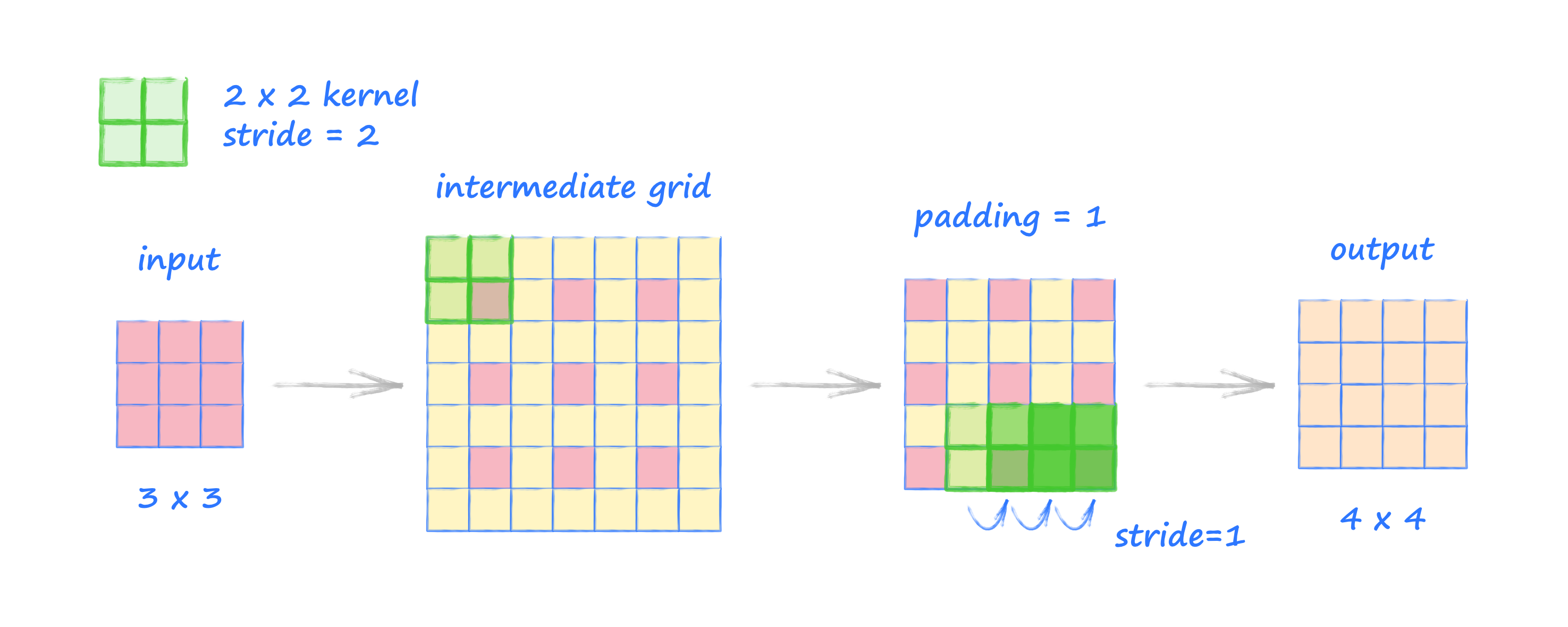
The main point of the guide is to develop an intuitive understanding, avoiding too much mathematical jargon.
An example of the friendly style of diagrams used ...
Contributor guide
First steps
- Read the whole issue, then the project's contributing guide.
- Comment on the issue to say you are picking it up — it saves two people doing the same work.
- Fork the repository and make your change on a branch.
- Open a pull request that references the issue number.
Research direction
Start by reviewing the linked convolution and transposed-convolution guide alongside the existing PyTorch tutorials. Done means determining whether the material should be included or linked, and identifying the appropriate tutorial location; the issue does not name a file or test.
Written by the indexing model from the issue text.
Assessment
- Tech stack
- pytorch
- Domain
- documentation, machine-learning
- Issue type
- Documentation
- Difficulty
- 3/5
- Estimated time
- 1-2 days
- Activity status
- Stale
- Clarity
- Mostly clear
- Newbie friendliness
- 35/100