DeepIV negative loss function
Nobody has claimed this yet.
- Dominant language
- Jupyter Notebook
- Stars
- 4.8k
- Forks
- 827
- PR merge metrics
- No merged PRs in 30d
Description
Hi,
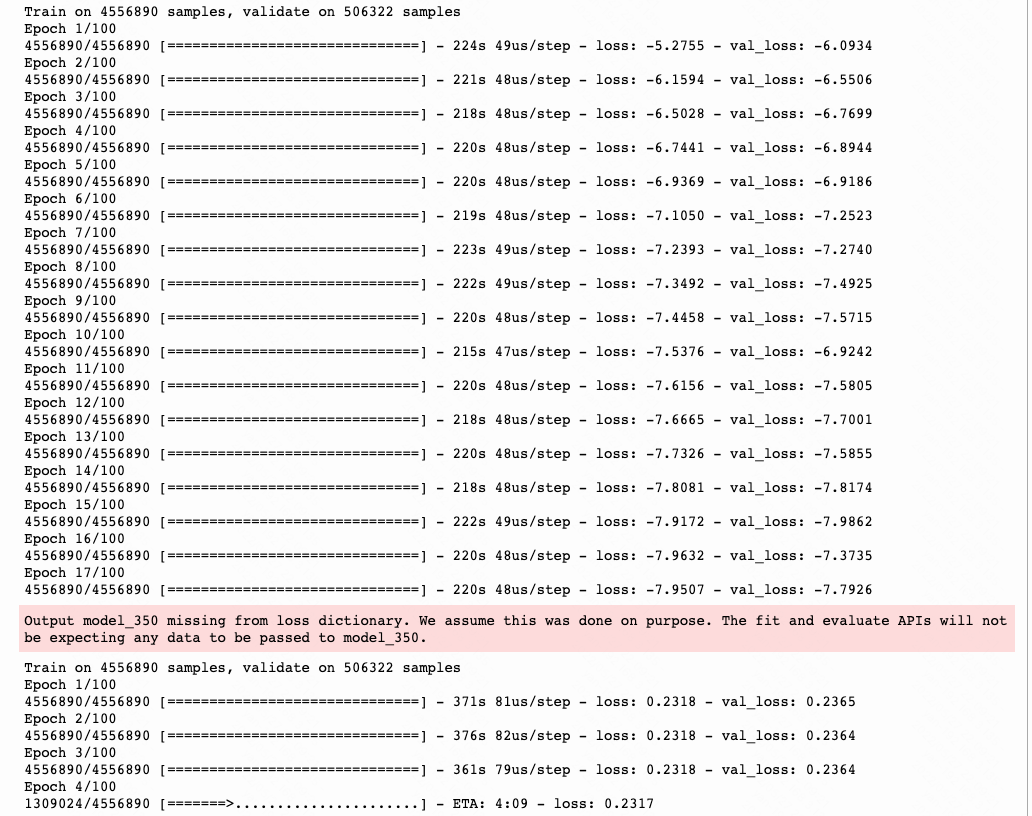
I tried to use the deepiv function with the microsoft tutorial and find the loss value is negative at first and then turns to positive. Here are also two reminders that "output model_344 and model_350 missing from loss dictionary".
How should I fixed this problem? Your help is much appreciated!
Here's my code, I have tried the model with my original data and normalized data:
treatment_model = keras.Sequential([keras.layers.Dense(128, activation='relu', input_shape=(5,)),
keras.layers.Dropout(0.0001),
keras.layers.Dense(64, activation='relu'),
keras.layers.Dropout(0.0001),
keras.layers.Dense(32, activation='relu'),
keras.layers.Dropout(0.0001)])
response_model = keras.Sequential([keras.layers.Dense(128, activation='relu', input_shape=(5,)),
keras.layers.Dropout(0.0001),
keras.layers.Dense(64, activation='relu'),
keras.layers.Dropout(0.0001),
keras.layers.Dense(32, activation='relu'),
keras.layers.Dropout(0.0001),
keras.layers.Dense(1)])
deepIvEst = DeepIV(n_components = 10, # number of gaussians in our mixture density network
m = lambda z, x : treatment_model(keras.layers.concatenate([z,x])), # treatment model
h = lambda t, x : response_model(keras.layers.concatenate([t,x])), # response model
n_samples = 1, # number of samples to use to estimate the response
use_upper_bound_loss = False, # whether to use an approximation to the true loss
n_gradient_samples = 1, # number of samples to use in second estimate of the response (to make loss estimate unbiased)
optimizer='Adagrad', # Keras optimizer to use for training - see https://keras.io/optimizers/
first_stage_options = keras_fit_options, # options for training treatment model
second_stage_options = keras_fit_options) # options for training response model
deepIvEst.fit(Y=y,T=t,X=x,Z=z)
Contributor guide
No contributing guide indexed for this repository
First steps
- Read the whole issue, then the project's contributing guide.
- Comment on the issue to say you are picking it up — it saves two people doing the same work.
- Fork the repository and make your change on a branch.
- Open a pull request that references the issue number.
Research direction
The report uses DeepIV with Keras models and the Microsoft tutorial; first reproduce it with the provided treatment_model, response_model, and DeepIV.fit call, then inspect the DeepIV loss path and the reported missing model entries. Done means establishing whether the initial negative loss and warnings are expected, or documenting a confirmed bug with a clear validation case.
Written by the indexing model from the issue text.
Assessment
- Tech stack
- keras, python, tensorflow
- Domain
- machine-learning
- Issue type
- Bug
- Difficulty
- 4/5
- Estimated time
- 3-5 days
- Activity status
- Stale
- Clarity
- Needs clarification
- Newbie friendliness
- 25/100