Question about a nearly perfect propensity model in doubly robust learning
Nobody has claimed this yet.
- Dominant language
- Jupyter Notebook
- Stars
- 4.8k
- Forks
- 827
- PR merge metrics
- No merged PRs in 30d
Description
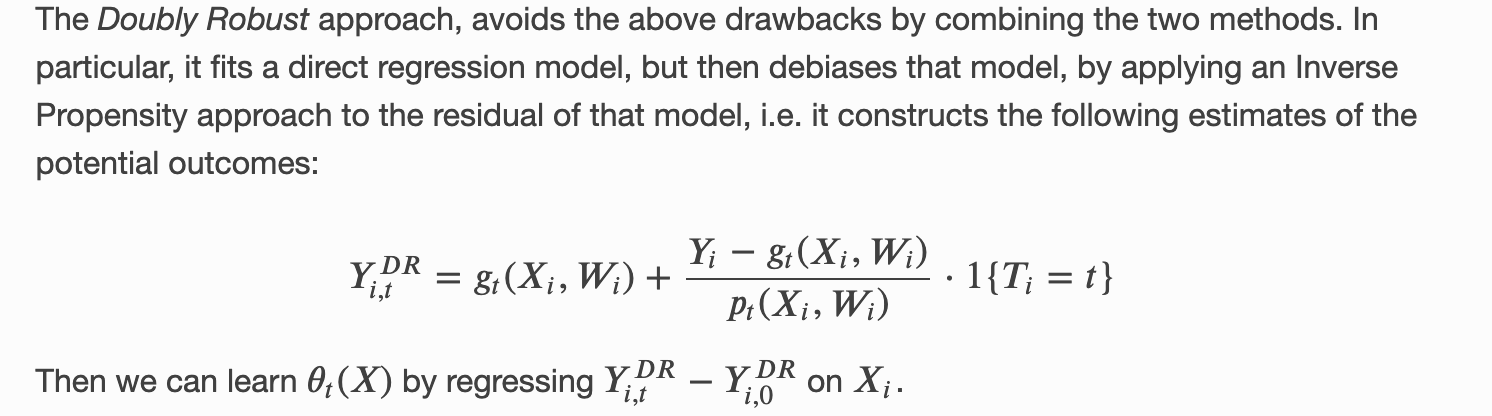
As stated in the title, if the propensity model in doubly robust learning is nearly perfect, then the inverse propensity weight would be extremely high, causing Y^{DR}_{i,t} to be inaccurate and the resulting causal model to be inaccurate. I am sure I'm missing something here.
Contributor guide
No contributing guide indexed for this repository
First steps
- Read the whole issue, then the project's contributing guide.
- Comment on the issue to say you are picking it up — it saves two people doing the same work.
- Fork the repository and make your change on a branch.
- Open a pull request that references the issue number.
Research direction
No source files, tests, or entry points are mentioned. Start by reviewing the doubly robust learning explanation referenced by the issue and verify how nearly perfect propensity estimates affect inverse propensity weights and the resulting estimator. Done means providing a clear resolution to the conceptual question or identifying the documentation that needs clarification.
Written by the indexing model from the issue text.
Assessment
- Domain
- machine-learning
- Issue type
- Documentation
- Difficulty
- 4/5
- Estimated time
- 3-5 days
- Activity status
- Stale
- Clarity
- Needs clarification
- Newbie friendliness
- 20/100