prometheus / prometheus/alertmanager
Proposal: Paginate through listAlertGroups API
Nobody has claimed this yet.
- Dominant language
- Go
- Stars
- 8.6k
- Forks
- 2.5k
- Avg merge
- 2d 6h
- Merged PRs (30d)
- 61
Description
ListAlertGroups API
Existing sorting behavior is: compare the label set of the alert group first:
If m has fewer labels than o, it is before o. If it has more, it is not.
If the number of labels is the same, the superset of all label names is sorted alphanumerically. The first differing label pair found in that order determines the outcome: If the label does not exist at all in m, then m is before o, and vice versa. Otherwise the label value is compared alphanumerically.
If m and o are equal, the method returns false.
If the alert group labels are the same, compare the receiver alphanumerically.
Paginate option:
Paginate through alert groups and only return first x alerts from every alert group
We will paginate on this ListAlertGroups API, we will only return first X (1000 maybe) alerts per alert group. If customer want to see more alerts inside of each alert group, they can call the listAlerts API with the filter like
/alertmanager/api/v2/alerts?filter=group%3Dhello1&receiver=example
API spec
- URL query parameters:
- maxAlertGroups Integer. The maximum number of alert group to return in one ListAlertGroups operation. The range is 1–1000. Optional
- maxAlertItem Integer. The maximum number of alerts returned under each alert group. default to 100 Optional
- nextToken String. The token for the next set of items to return. (You received this token from a previous call.). Optional
- active Boolean. If true, the returned list includes active alerts. The default is true. Optional
- silenced Boolean. If true, the returned list includes silenced alerts. The default is true. Optional
- inhibited Boolean. If true, the returned list includes inhibited alerts. The default is true. Optional
- unprocessed Boolean. If true, the returned list includes unprocessed alerts. The default is true. Optional
- filter An array of strings. A list of matchers to filter alerts by. Optional
- receiver String. A regular expression matching receivers to filter alerts by. Optional
- Sample response
-
    groups: [
        {
          "alerts": [
            {
              "annotations": {
                "summary": ""
              },
              "endsAt": "2030-06-15T21:17:27.369Z",
              "fingerprint": "08f58215e96e440b",
              "receivers": [
                {
                  "name": "example-sns"
                }
              ],
              "startsAt": "2030-06-15T21:17:27.369Z",
              "status": {
                "inhibitedBy": [],
                "silencedBy": [],
                "state": "active"
              },
              "updatedAt": "2023-03-15T09:35:46.195Z",
              "generatorURL": "http://localhost:8080/uri",
              "labels": {
                "alertname": "0122de25-ac2a-49d2-89d4-ddf4b349ed9a",
                "group": "hello1"
              }
            }
          ],
          "labels": {
            "group": "hello1"
          },
          "receiver": {
            "name": "example-sns"
          },
          "route": "{ROUTE_UUID}"
        },
        {
          "alerts": [],
          "labels": {
            "group": "hello2"
          },
          "receiver": {
            "name": "example-sns"
          },
          "route": "{ROUTE_UUID}"
        }
      ],
      nextToken:"123"
Pros
- Easy to implement
- We will add the pagination support for an existing API
Cons
- Need to change the API return response behavior(extra field for parameters)
- We need to introduce an optional field to let customer choose if return truncated result
- Or We need to do v3 of the API for backward compatibility and not breaking customer
- Need to change the existing sorting behavior of current listAlertGroups API
Do not paginate, only return first x alerts from every alert group
We will not paginate on this ListAlertGroups API, we will only return first X (1000 maybe) alerts per alert group. If customer want to see more alerts inside of each alert group, they can call the listAlerts API with the filter like
/alertmanager/api/v2/alerts?filter=group%3Dhello1&receiver=example
This will filter label group=hello1 and reciever in example
Pros
- Easy to implement
- Do not need to change the existing sorting behavior of current listAlertGroups API
Cons
- Need to change the API return response behavior
- We need to introduce an optional field to let customer choose if return truncated result
- Or We need to do v3 of the API for backward compatibility and not breaking customer
Brand new API to return the alert group without alerts
We will create a new API that will only return a list of alert group without the alerts, for example:
[
    {
        "labels": {
            "group": "hello1"
        },
        "receiver": {
            "name": "example-sns"
        }
    },
    {
        "labels": {
            "group": "hello2"
        },
        "receiver": {
            "name": "example-sns"
        }
    }
]
If customer want to see the alerts inside of each alert group, they can call the listAlerts API with the filter like
alertmanager/api/v2/alerts?filter=group%3Dhello1&receiver=example
This will filter label group=hello1 and reciever in example.
Pros
- No change for the existing listAlertGroups API
Cons
- Grafana need to do 2 level API call in order to render existing alert group page
Flatten the construct
We will have to add two more field in the alerts attribute to identify the alert group each alert is belong to, the construct from ListAlertGroups API result will turn into :
[
    {
    "annotations": {
        "summary": ""
    },
    "endsAt": "2030-06-15T21:17:27.369Z",
    "fingerprint": "08f58215e96e440b",
    "receivers": [
        {
        "name": "example-sns"
        }
    ],
    "startsAt": "2030-06-15T21:17:27.369Z",
    "status": {
        "inhibitedBy": [],
        "silencedBy": [],
        "state": "active"
    },
    "updatedAt": "2023-03-15T09:35:46.195Z",
    "generatorURL": "http://localhost:8080/uri",
    "labels": {
        "alertname": "0122de25-ac2a-49d2-89d4-ddf4b349ed9a",
        "group": "hello1"
    },
    "groupLabels": {
        "group": "hello1"
    },
    "groupReceiver": {
        "name": "example-sns"
    }
    }
]
Sorting will be sort by the alert group fingerprint first and then the alerts inside of alert group
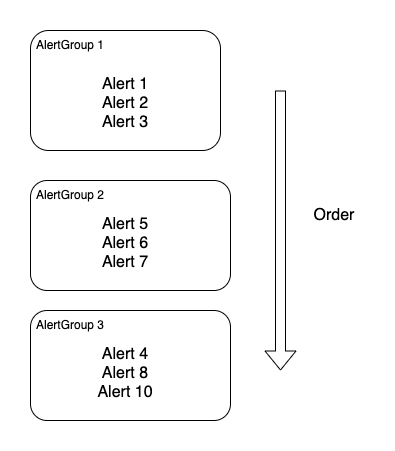
PaginationToken
The pagination token will be the fingerprint of the start alert group + “_” + fingerprint of the start alert
Pros
- Return the whole information in single API
Cons
- Need to change the API return response structure
- We need to do v3 of the API for backward compatibility and not breaking customer
- Need to change the existing sorting behavior of current listAlertGroups API
UI change
- Filter change Similar change that grafana need to do, switch to service side filtering
- Custom grouping change
- Silence, inhibited filtering change to switch to service side filtering
Contributor guide
No contributing guide indexed for this repository
First steps
- Read the whole issue, then the project's contributing guide.
- Comment on the issue to say you are picking it up — it saves two people doing the same work.
- Fork the repository and make your change on a branch.
- Open a pull request that references the issue number.
Research direction
Start at the existing ListAlertGroups and listAlerts API entry points, using the proposed query parameters, response examples, and sorting rules as the requirements. Before implementation, choose among the four alternatives, settle backward-compatibility and pagination-token behavior, and define acceptance checks for pagination, filtering, sorting, and the UI changes.
Written by the indexing model from the issue text.
Assessment
- Tech stack
- go
- Domain
- api, backend
- Issue type
- Feature
- Difficulty
- 5/5
- Estimated time
- Over a week
- Activity status
- Stale
- Clarity
- Needs clarification
- Newbie friendliness
- 25/100