[Enhancement] Vertically demonstrate dependency as a tree.
Nobody has claimed this yet.
- Dominant language
- JavaScript
- Stars
- 706
- Forks
- 117
- Avg merge
- 8h 50m
- Merged PRs (30d)
- 18
Description
https://github.com/tasks/tasks/issues/1868#issue-1222154156 describes the request, whereas https://github.com/nextcloud/tasks/issues/2185#issue-1561309542 demonstrates the necessity of this.
Request
Many possible methods of easy demonstration of dependency exist, and each provides unique advantages.
Examples:
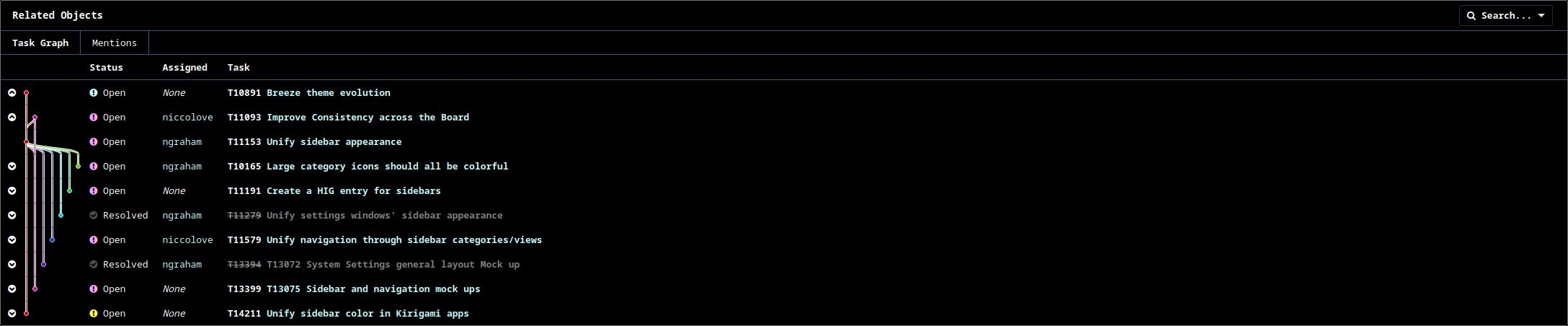
Tree
Provides additional information whilst displaying relationships in an intuitive manner.
Examples:
GitKraken
https://www.gitkraken.com/github-student-developer-pack-bundle
Phabricator
Mindmap
Conversely,
<iframe src="https://anvaka.github.io/sayit/?query=tasks"></iframe> <!-- https://github.com/github/markup/issues/538#issuecomment-786402900 -->is able to demonstrate complex relation. However it does so without cohesive presentation of additional information, although a basic nested table
flowchart TD
    A[Task] --> B[<b>Relation</b><br><table><tbody><tr><td><b>Attribute</b></td><td>Value</td></tr><tr><td><b>Attribute</b></td><td>Value</td></tr></tbody></table>]
    A --> C[<b>Relation</b><br><table><tbody><tr><td><b>Attribute</b></td><td>Value</td></tr><tr><td><b>Attribute</b></td><td>Value</td></tr></tbody></table>]
    B --> D[Relation]
    A --> E[Relation]
    B --> F[Relation]
    G[Relation] --> B
    A --> H[Relation]
is not an infeasible manner of overcoming this barrier.
However, I believe that how Phabricator implemented this ability^0 is ideal (scroll to the Task Graph if your browser does not automatically) because it provides the advantages of the previous methods, yet provides intuitive vertical presentation of information, and retains the current list as the primary interface.
This is dependent upon implementation of https://github.com/tasks/tasks/issues/1867#issue-1222152770. It may be a duplicate of https://github.com/tasks/tasks/issues/452#issue-182067503, but I am not confident that it is.
Correlations
Contributor guide
First steps
- Read the whole issue, then the project's contributing guide.
- Comment on the issue to say you are picking it up — it saves two people doing the same work.
- Fork the repository and make your change on a branch.
- Open a pull request that references the issue number.
Research direction
Start by reviewing the linked issues 1867 and 452 to understand the dependency model and whether this request is a duplicate. Done means presenting task dependencies as an intuitive vertical tree while retaining the current list as the primary interface.
Written by the indexing model from the issue text.
Assessment
- Tech stack
- javascript
- Domain
- frontend
- Issue type
- Feature
- Difficulty
- 5/5
- Estimated time
- Over a week
- Activity status
- Stale
- Clarity
- Mostly clear
- Newbie friendliness
- 35/100