Do large negative user biases mean anything?
- Dominant language
- Python
- Stars
- 5.1k
- Forks
- 724
- PR merge metrics
- No merged PRs in 30d
Description
I have created a LightFM model that recommends users movies and TV series based on their viewing history. The model works reasonably well, with a test AUC score around 0.75 and a test precision@K=15 score around 0.05. Subjectively speaking, the generated recommendations are fine although a bit more generic/less diverse than I'd ideally want.
I was looking at the user biases, and noticed that they're all large and negative (with a mean around -175) both for users with few and for users with many interactions. The item biases (and user/item embeddings) look "normal", lying in a range between roughly -0.5 and 0.5.
Does this mean anything, e.g. that the model hasn't converged properly?
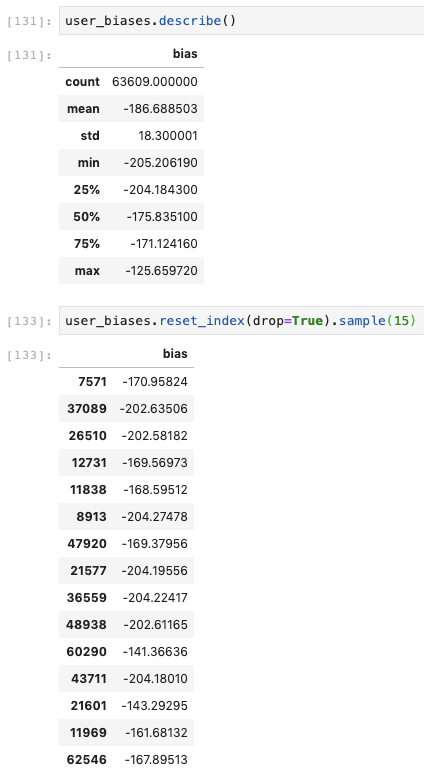
Some additional details about the data and model: each item and user has several features indicating things like genre (item) and geographical location (user). The model parameters are as follows: no_components=37, max_sampled=30, loss='warp', learning_rate=0.05, item_alpha=1e-4, user_alpha=1e-4, epochs=430.
Contributor guide
No contributing guide indexed for this repository
Research direction
No source file or test is identified. Start by reviewing the LightFM model configuration and the reported user/item bias outputs, then determine whether the large negative user biases indicate a convergence or interpretation problem; done means documenting a supported explanation or a reproducible defect.
Written by the indexing model from the issue text.
Assessment
- Tech stack
- python
- Domain
- machine-learning
- Issue type
- Bug
- Difficulty
- 5/5
- Estimated time
- Over a week
- Activity status
- Stale
- Clarity
- Needs clarification
- Newbie friendliness
- 25/100