Rendering 2D images from VoxelBlockGrid matching TSDF input given only camera extrinsics
- Dominant language
- C++
- Stars
- 14k
- Forks
- 2.6k
- Avg merge
- 5d 18h
- Merged PRs (30d)
- 6
Description
### Checklist
- [X] I have searched for [similar issues](https://github.com/isl-org/Open3D/issues).
- [X] For Python issues, I have tested with the [latest development wheel](http://www.open3d.org/docs/latest/getting_started.html#development-version-pip).
- [X] I have checked the [release documentation](http://www.open3d.org/docs/release/) and the [latest documentation](http://www.open3d.org/docs/latest/) (for `master` branch).
### My Question
Dear all,
I have a problem trying to finding an accurate way to generate 2D images from a TSDF VoxelBlockGrid that look identical to the input images when given only the camera extrinsics/intrinsics.
I am basicaly trying to integrate a series of RGB-D images (+extrinsics) into one 3D model, just as was done [in this example](https://github.com/isl-org/Open3D/blob/master/examples/python/t_reconstruction_system/integrate.py). I however additionally want to make a rendering of the next frame each step before integrating the next RGB-D image, only using the camera extrinsics.
I tried different methods, the best one I've found was to use a [Visualizer](http://www.open3d.org/docs/release/python_api/open3d.visualization.Visualizer.html) and to capture a screen image. In order to get the camera in the right position, I set the cameras extrinsics and intrinsics of the view control and render the image. Here is the code for the rendering steps using the TSDF VoxelBlockGrid:
```
mesh = vbg.extract_triangle_mesh().to_legacy()
vis = o3d.visualization.Visualizer()
vis.create_window(width=640, height=480, visible=False)
vis.add_geometry(mesh)
depth_intrinsic_o3d = o3d.camera.PinholeCameraIntrinsic(width=width, height=height, fx=depth_int_mat[0,0], fy=depth_int_mat[1,1], cx=depth_int_mat[0,2], cy=depth_int_mat[1,2])
color_intrinsic_o3d = o3d.camera.PinholeCameraIntrinsic(width=width, height=height, fx=color_int_mat[0,0], fy=color_int_mat[1,1], cx=color_int_mat[0,2], cy=color_int_mat[1,2])
view_ctl = vis.get_view_control()
cam = view_ctl.convert_to_pinhole_camera_parameters()
cam.intrinsic = depth_intrinsic_o3d
cam.extrinsic = extrinsic_mat
view_ctl.convert_from_pinhole_camera_parameters(cam, True)
filename = "tsdf_fusion/o3d_renderings/rendering%04d.png"%(i)
vis.capture_screen_image(filename, do_render=True)
#vis.run()
vis.destroy_window()
vis.close()
```
I am using the [ScanNet](http://www.scan-net.org/) dataset and tested it with both provided depth and color intrinsics (which I also used for the integration). Both results are not a fully accurate reconstruction in terms of their perspective. Here a comparison:
Original image:
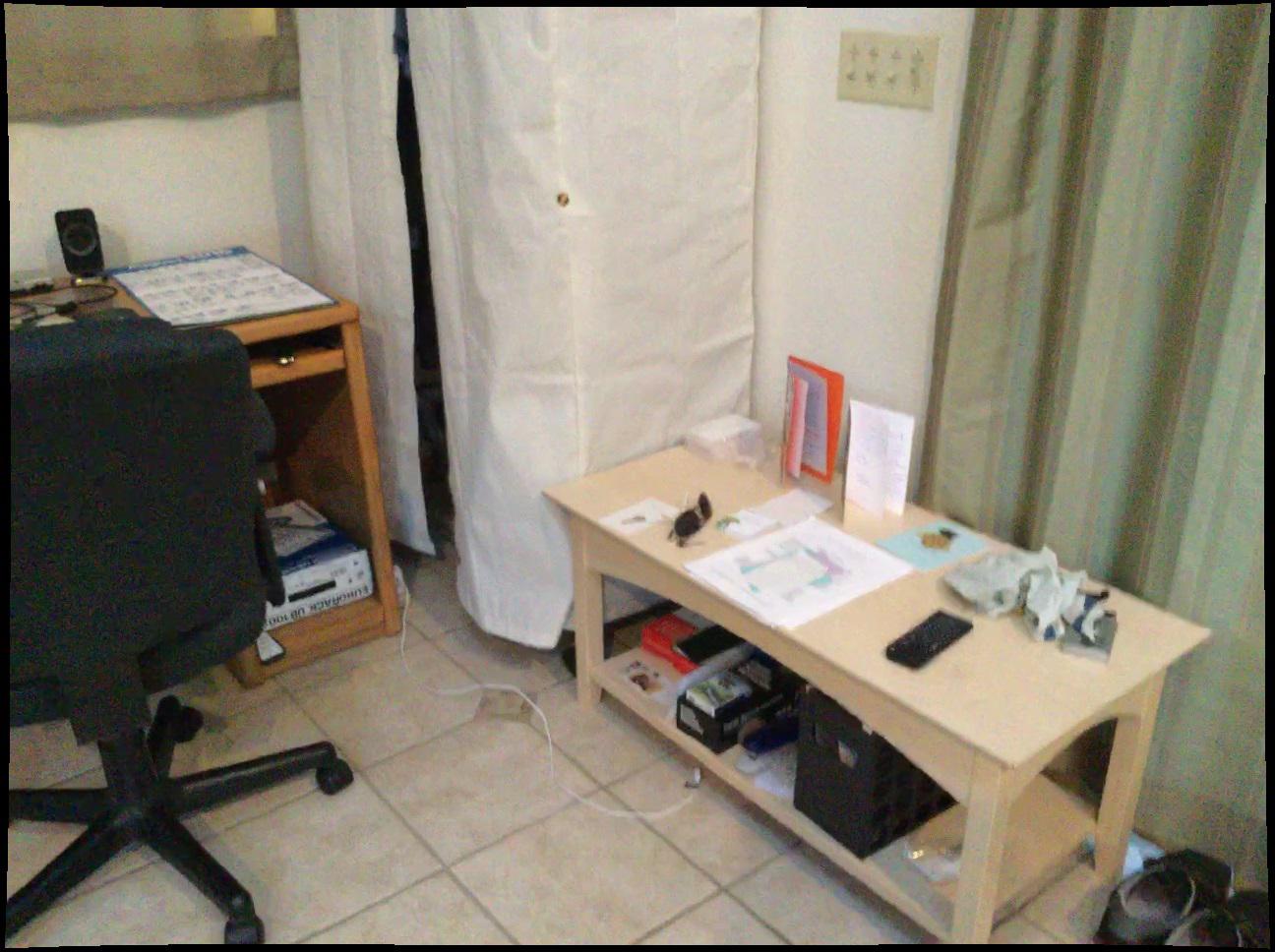
Using color intrinsics:

Using depth intrinsics:

It looks like the camera positioning is accurate, so it might be possible to fix the issue by simply using the correct intrinsics.
So the first important question is: _**Is there a way to find the intrinsics needed to get the right perspective?**_
After all, the TSDF algorithm is based on the two intrinsics provided, so there should be a way to determine which are the corresponding intrinsics in the virtual camera.
This of course is only one attempt, I tried other methods where the results were even worse. I have so far not looked into other 3D model generation methods other than TSDF.
So if somebody has any better ideas: _**What better ways are there in terms of 3D integration/image rendering that might be better suited for this task?**_
In my case, it is unfortunately not possible to use the view frustum coordinates, as calculating them would require the use of the depth image in addition to the extrinsics.
I hope my question is clear and not too broad! I would appreciate any help, as I am stuck on this issue for a while now!
If any more information or code pieces is needed for clarification, I would be glad to provide them!
Thanks in advance!
Contributor guide
No contributing guide indexed for this repository
Assessment
This issue has not been assessed yet.