huggingface / huggingface/pytorch_block_sparse
Sparse pattern is not guaranteed to be full rank
- Dominant language
- C++
- Stars
- 551
- Forks
- 34
- PR merge metrics
- No merged PRs in 30d
Description
Hi,
First, thanks for this code! ;)
From my understanding the sparsity pattern for the block is fully random. This is concerning since it leads to non-full rank matrices when increasing sparsity. See the figure below which `BlockSparseLinear` generated for a 256x256 matrix with 25% density and 32x32 blocks:
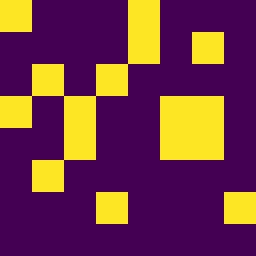
If my computation is correct, at this size, block size and sparsity, only around 20% of matrices will be full rank or, for another example, only 10% of 1024x1024 matrices at 10% density will be full rank), and, if I am not completely mistaken (I might yet be), 0% of the matrices created in the README `self.fc = BlockSparseLinear(1024, 256, density=0.1)`
I don't have any good option to propose though sorry, I see only 2 complementary ways:
- preselecting some of the tiles to make sure all input data is used and all output data is filled (eg: diagonal pattern for a square matrix),
- adding an API for users to provide the sparsity pattern they want to use if they need more flexibility (eg: `BlockSparseLinear.from_pattern(pattern: torch.Tensor, block_shape: Tuple[int, int])`, but then it's no more a "drop in replacement" to a linear layer)
Contributor guide
No contributing guide indexed for this repository
Assessment
This issue has not been assessed yet.