polygon_data_set::insert creates unwanted polygon point
- Dominant language
- C++
- Stars
- 70
- Forks
- 75
- PR merge metrics
- No merged PRs in 30d
Description
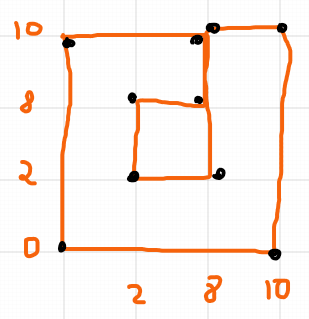
I want to represent a donut shape with `boost::polygon`, such as the figure below, with the following points:
```
10 polygon : (0, 0), (10, 0), (10, 10), (8, 10), (8, 2), (2, 2), (2, 8), (8, 8), (8, 10), (0, 10),
```
Once I include the polygon into a [polygon set data](https://www.boost.org/doc/libs/1_73_0/libs/polygon/doc/gtl_custom_polygon_set.htm), however, it creates an additional unwanted point `(8,8)` from `(8,10)->(8,2)`. Even `boost::polygon::simplify` leaves this point. Is that the expected behavior?
```
12 insert : (10, 10), (8, 10), (8, 8), (8, 2), (2, 2), (2, 8), (8, 8), (8, 10), (0, 10), (0, 0), (10, 0), (10, 10),
12 simplf : (10, 10), (8, 10), (8, 8), (8, 2), (2, 2), (2, 8), (8, 8), (8, 10), (0, 10), (0, 0), (10, 0), (10, 10),
```
```
#include
#include
#include
#include
#include
#include
using namespace boost::assign;
namespace gtl = boost::polygon;
using namespace boost::polygon::operators;
//--------------------------------------------------------------------------------
// CPoint
//--------------------------------------------------------------------------------
struct CPoint {
//CPoint() : x(0), y(0) {}
//CPoint(int a, int b) : x(a), y(b) {}
int x;
int y;
};
namespace boost::polygon {
template <>
struct geometry_concept { typedef point_concept type; };
template <>
struct point_traits {
typedef int coordinate_type;
static inline coordinate_type get(const CPoint& point, orientation_2d orient) {
return ((orient == HORIZONTAL) ? point.x : point.y);
}
};
template <>
struct point_mutable_traits {
typedef int coordinate_type;
static inline void set(CPoint& point, orientation_2d orient, int value) {
if(orient == HORIZONTAL)
point.x = value;
else
point.y = value;
}
static inline CPoint construct(int x_value, int y_value) {
CPoint retval;
retval.x = x_value;
retval.y = y_value;
return retval;
}
};
}
//--------------------------------------------------------------------------------
// CPolygon
//--------------------------------------------------------------------------------
typedef std::list CPolygon;
namespace boost::polygon {
template <>
struct geometry_concept{ typedef polygon_concept type; };
template <>
struct polygon_traits {
typedef int coordinate_type;
typedef CPolygon::const_iterator iterator_type;
typedef CPoint point_type;
static inline iterator_type begin_points(const CPolygon& t) { return t.begin(); }
static inline iterator_type end_points(const CPolygon& t) { return t.end(); }
static inline std::size_t size(const CPolygon& t) { return t.size(); }
static inline winding_direction winding(const CPolygon& t) { return unknown_winding; }
};
template <>
struct polygon_mutable_traits {
template
static inline CPolygon& set_points(CPolygon& t, iT input_begin, iT input_end) {
t.clear();
while(input_begin != input_end) {
t.push_back(CPoint());
gtl::assign(t.back(), *input_begin);
++input_begin;
}
return t;
}
};
}
std::ostream &operator<<(std::ostream &os, const CPoint &p) {
return os << "(" << p.x << ", " << p.y << ")";
}
std::ostream &operator<<(std::ostream &os, const CPolygon &p) {
for (const auto point : p)
os << point << ", ";
return os;
}
int main()
{
CPolygon donut{
CPoint{0, 0}, CPoint{10,0}, CPoint{10, 10},
CPoint{8, 10}, CPoint{8, 2},
CPoint{2, 2}, CPoint{2, 8}, CPoint{8, 8},
CPoint{8,10}, CPoint{0,10} };
std::cout << donut.size() << " donut : " << donut << std::endl;
boost::polygon::polygon_set_data ps;
std::vector polygons;
ps.insert(donut);
ps.get(polygons);
for (const auto &pl : polygons)
std::cout << pl.size() << " insert : " << pl << std::endl;
polygons.clear();
boost::polygon::simplify(ps, 1e-3);
ps.get(polygons);
for (const auto &pl : polygons)
std::cout << pl.size() << " simplf : " << pl << std::endl;
return 0;
}
```
Contributor guide
No contributing guide indexed for this repository
Assessment
This issue has not been assessed yet.