🐛 Bug Report: MCP over OAuth 2.1 unusable against a path-scoped PRM resource (Grafana Cloud MCP), and silent in the UI
- Dominant language
- Python
- Stars
- 18.3k
- Forks
- 2.1k
- Avg merge
- 1d 2h
- Merged PRs (30d)
- 29
Description
## 📜 Description
An MCP server whose OAuth 2.1 Protected Resource Metadata advertises a **path-scoped**
`resource` (for example Grafana Cloud MCP, `https://mcp.grafana.com/mcp`, whose PRM
publishes `resource: https://mcp.grafana.com/mcp`) cannot be connected from DocsGPT.
Five independent defects sit on the same path. Each one is only reachable after the
previous one is fixed, and the first two surface no message at all in the UI.
Defects 1–4 are backend one-liners and I have a branch with tests for them. Defect 5
touches the save route's contract and is reported here for discussion rather than
patched blind.
**1. The OAuth resource indicator is derived from the origin, not the endpoint.**
`DocsGPTOAuth.__init__` strips the path and passes only `scheme://netloc` to
`OAuthClientProvider`:
```python
parsed_url = urlparse(mcp_url)
self.server_base_url = f"{parsed_url.scheme}://{parsed_url.netloc}"
...
super().__init__(server_url=self.server_base_url, ...)
```
The SDK validates in one direction only
(`mcp/client/auth/oauth2.py::_validate_resource_match`):
```python
default_resource = resource_url_from_server_url(self.context.server_url)
if not check_resource_allowed(requested_resource=default_resource, configured_resource=prm_resource):
raise OAuthFlowError(f"Protected resource {prm_resource} does not match expected {default_resource}")
```
`check_resource_allowed` requires the *requested* path to start with the *configured*
path, so a token for a parent resource may be used for its children — not the reverse.
With the origin, `"/"` does not start with `"/mcp/"` and the flow dies before any
authorization URL is produced:
```
Protected resource https://mcp.grafana.com/mcp does not match expected https://mcp.grafana.com
```
This affects **any** MCP server that scopes its PRM `resource` to a path, not just
Grafana.
**2. `/api/mcp_server/test` drops `task_id`, so the consent popup never opens.**
`MCPTool._start_oauth_task` returns `success`, `requires_oauth`, `task_id`, `message`
and `tools_count` — and no `auth_url`, because the authorization URL is only known
later and arrives over SSE. The route allowlists a field set that excludes `task_id`:
```python
if k in ("success", "requires_oauth", "auth_url")
```
`frontend/src/modals/MCPServerModal.tsx` gates the whole OAuth branch on it:
```ts
if (formData.auth_type === 'oauth' && result.requires_oauth && result.task_id) { ... }
else { setTestResult(result); ... }
```
So the response carries `{"success": false, "requires_oauth": true}` and falls into the
`else`, which stores it as the test result. That object has no `message`, and the
`errors.testFailed` string is only set in the `catch` branch — which does not run,
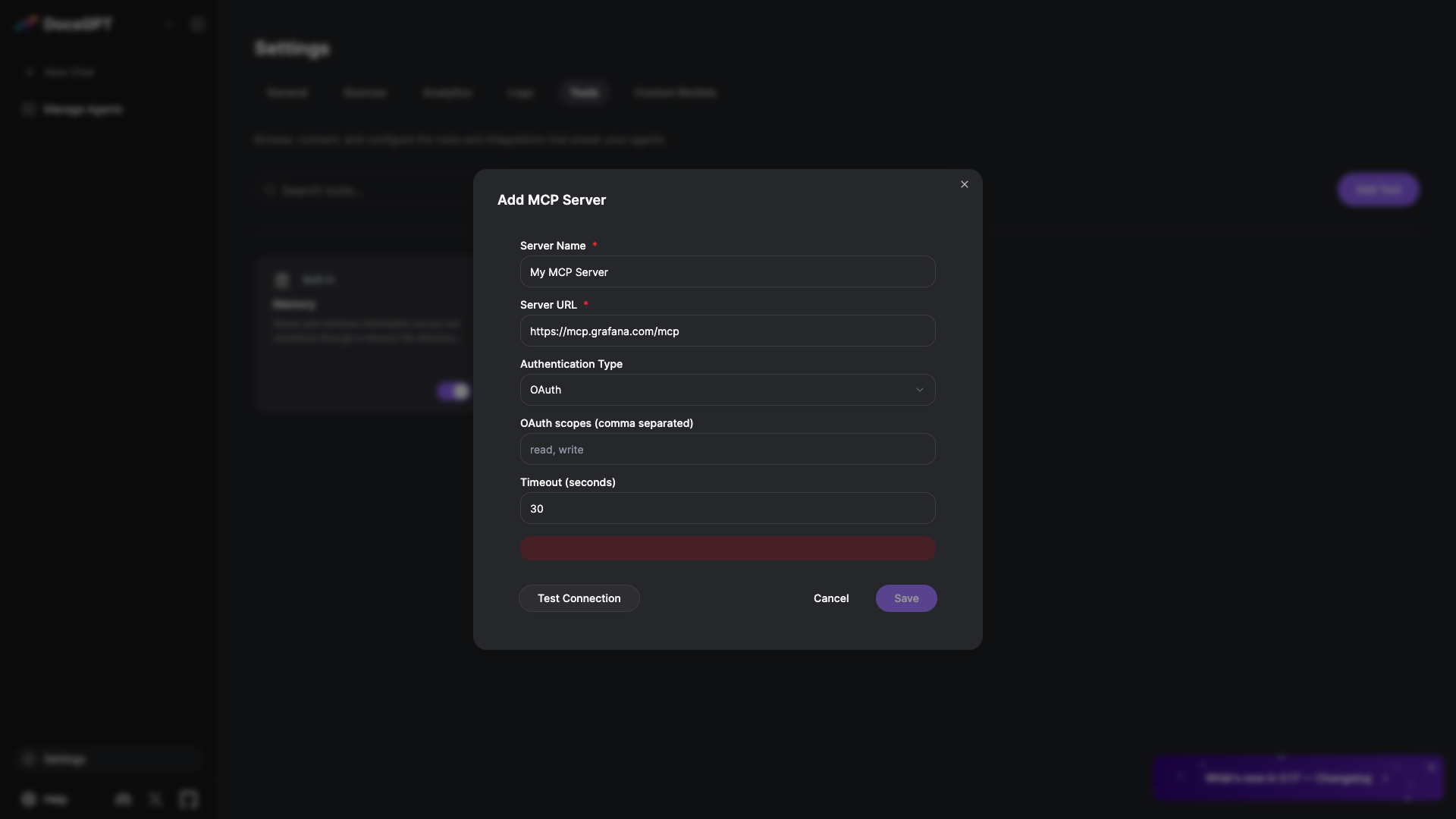
because the request succeeded with HTTP 200. The user gets an **empty red error
banner**: no text at all, while the Celery worker has already started a flow it can
never hand back.
**3. A schema with no `properties` is stored as a property named `type`.**
`MCPTool.get_actions_metadata` treats an `inputSchema` without a `properties` key as a
flat map of property definitions:
```python
if "properties" in input_schema:
...
else:
parameters_schema["properties"] = input_schema
```
`{"type": "object"}` is a valid MCP `inputSchema` meaning "this tool takes no
arguments" — Grafana Cloud MCP sends it for `list_investigation_profiles` among
others. It gets stored as `{"properties": {"type": "object"}}`, i.e. a property named
`type` whose definition is the string `"object"`. The sibling case
`{"type": "object", "properties": null}` takes the first branch and stores
`properties: None`.
**4. Two consumers assume every property value is a mapping.**
`transform_actions` (`application/api/user/tools/routes.py`) writes into each property
definition, so saving raises and the UI shows **"Failed to save MCP server"**:
```
TypeError: 'str' object does not support item assignment
```
`ToolExecutor._build_tool_parameters` reads from each property definition, so the next
chat turn raises and the UI shows **"Please try again later"**:
```
AttributeError: 'str' object has no attribute 'get'
```
Because the malformed value is already persisted, fixing only defect 3 leaves
existing tools broken.
**5. Once a token is stored, the server can never be saved.**
`MCPTool._test_oauth_connection` short-circuits when a token is already in storage: it
discovers the tools with that token and returns success, **without** going through
`_start_oauth_task`, so the response carries no `task_id`. Only when there is no token,
or it fails, is a task started.
`MCPServerSave` hard-requires one:
```python
if auth_type == "oauth":
if not config.get("oauth_task_id"):
return make_response(jsonify({
"success": False,
"error": "Connection not authorized. Please complete the OAuth authorization first.",
}), 400)
```
and takes `actions_metadata` only from the task result, never from a direct discovery.
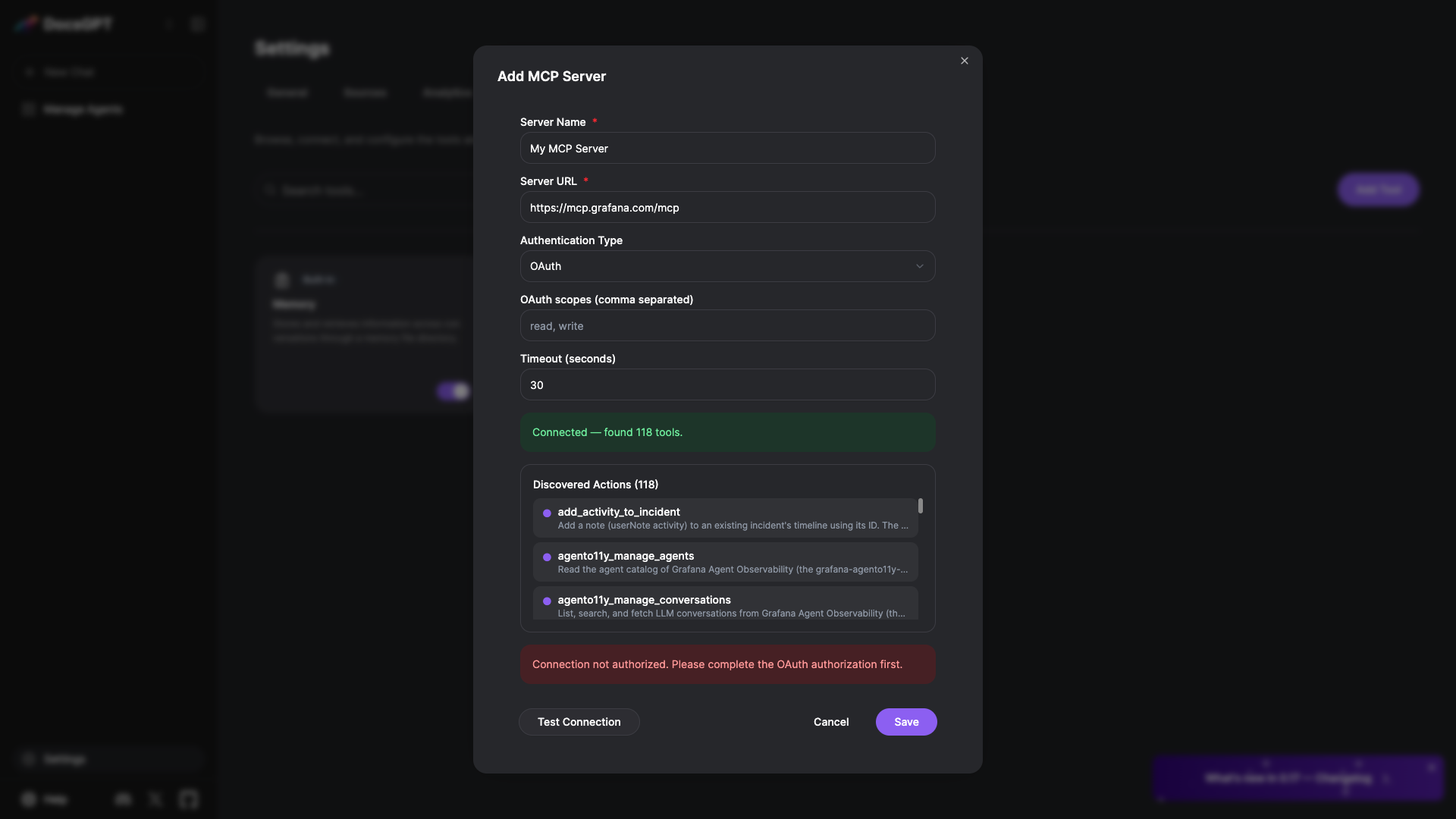
So after the first successful authorization the two halves disagree permanently:
```
POST /api/mcp_server/test -> 200 {"success": true, "message": "Connected — found 118 tools.", "tools": [...]}
POST /api/mcp_server/save -> 400 {"error": "Connection not authorized. Please complete the OAuth authorization first."}
```
There is no way out from the UI: pressing *Test Connection* again keeps succeeding from
the stored token and keeps returning no `task_id`. It is reachable by simply closing the
modal after authorizing and reopening it, or by deleting the tool and adding the same
server again.
## 👟 Reproduction steps
No Grafana account is needed for steps 1–3: the PRM check fails before any consent
screen. `docker compose -f deployment/docker-compose.yaml up` with
`LLM_PROVIDER=docsgpt` is enough.
1. Settings → Tools → Add Tool → **MCP Tool**.
2. In the *Add MCP Server* modal set Server URL `https://mcp.grafana.com/mcp` and
Authentication Type **OAuth**. Leave the rest at their defaults.
3. Click **Test Connection**.
→ UI: an empty red error banner, no text.
→ `POST /api/mcp_server/test` returns `200 {"requires_oauth": true, "success": false}`.
→ Worker log:
```
mcp.client.auth.exceptions.OAuthFlowError: Protected resource
https://mcp.grafana.com/mcp does not match expected https://mcp.grafana.com
```
4. Fix defect 1 only, click **Test Connection** again.
→ The worker now reaches `POST /mcp/oauth/register → 201` and produces an
authorization URL, but the UI still shows the empty banner and no consent popup,
because `task_id` never reaches the client.
5. Fix defect 2 only, complete the Grafana consent screen, click **Save**.
→ HTTP 500, `TypeError: 'str' object does not support item assignment`.
6. Fix defect 3 only, save succeeds for a newly added server, but any tool already
stored still raises on the next chat turn:
`AttributeError: 'str' object has no attribute 'get'`.
7. With defects 1–4 fixed and a token now stored, close the modal and add the same
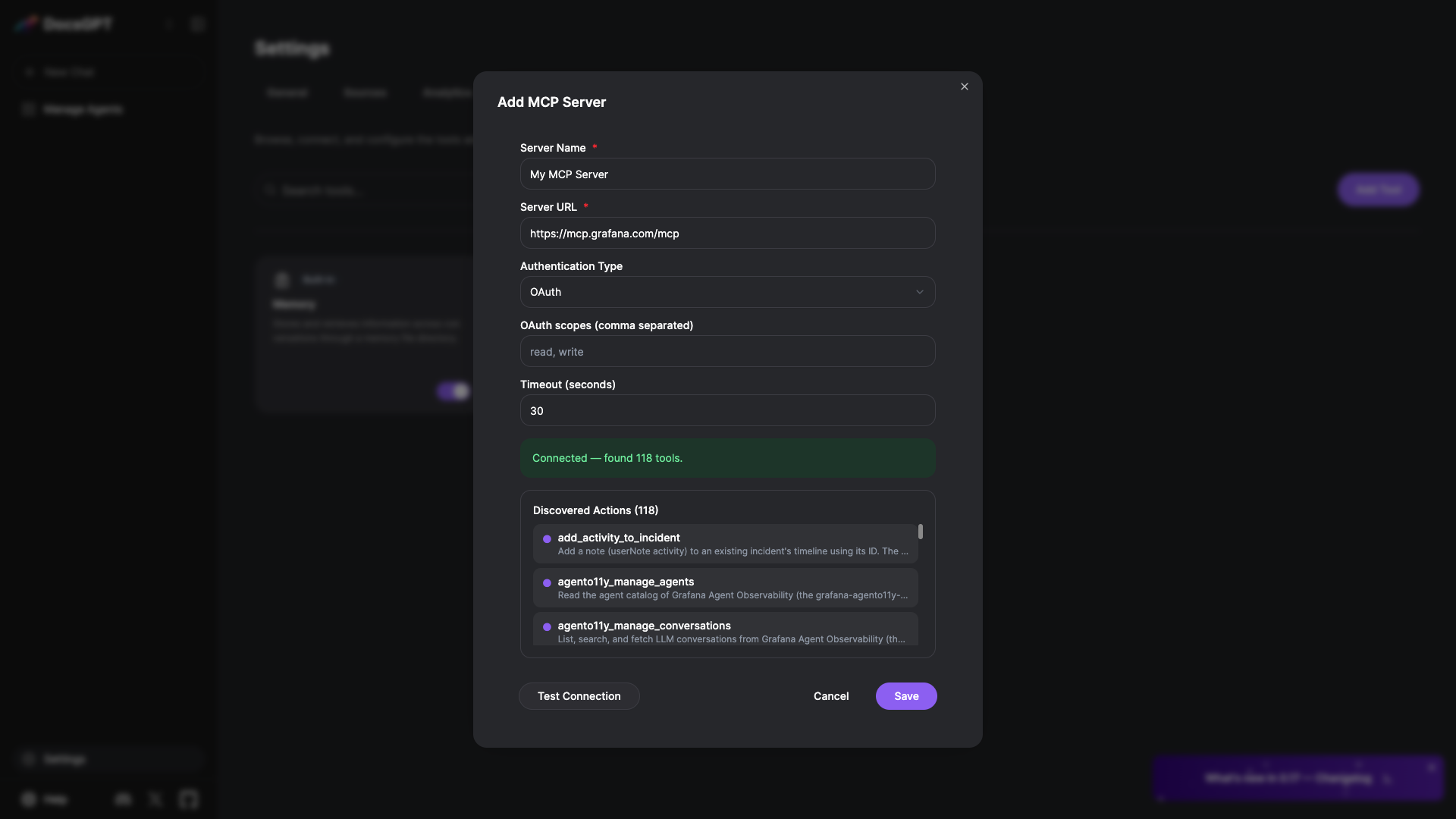
server again. *Test Connection* reports `Connected — found 118 tools.` and **Save**
returns 400 `Connection not authorized. Please complete the OAuth authorization
first.`, with no way to recover from the UI.
Defects 3 and 4 can be reproduced without the consent screen, by driving the same
functions with the schema Grafana publishes:
```python
from application.agents.tools.mcp_tool import MCPTool
from application.api.user.tools.routes import transform_actions
tool.available_tools = [{"name": "list_investigation_profiles", "inputSchema": {"type": "object"}}]
actions = tool.get_actions_metadata()
# -> {'type': 'object', 'properties': {'type': 'object'}, 'required': []}
transform_actions(actions)
# -> TypeError: 'str' object does not support item assignment
```
## 👍 Expected behavior
Connecting an MCP server whose PRM `resource` includes a path completes the OAuth
flow, saves, and its tools are usable in chat. A tool that declares no arguments is
stored with `properties: {}`. A property definition DocsGPT cannot interpret is
skipped rather than turned into a 500. When a test fails, the UI says something. A test
that reports 118 discovered tools can be saved.
## 👎 Actual Behavior with Screenshots
The five failures above, in sequence. The first two are silent: the banner that the
modal renders is empty, because the response has no `message` field and the
`errors.testFailed` string is only used for transport-level failures. The specifics
exist only in the API and worker logs.
Defects 1 and 2 on `main` — *Test Connection* renders a red banner with no text:
With defects 1–4 fixed, the same input completes the flow:
Defect 5, reached from that same state after closing and reopening the modal — the
test succeeds from the stored token and the save is refused:
## 💻 Operating system
Linux
## 🤖 What development environment are you experiencing this bug on?
Docker
## 📃 Provide any additional context for the Bug.
Reproduced on `main` at 618079a4 with `deployment/docker-compose.yaml`
(`LLM_PROVIDER=docsgpt`, no API key), `mcp` SDK 1.29.1, against Grafana Cloud MCP.
Also seen on `arc53/docsgpt:latest` in a Kubernetes deployment.
Out of scope here, noted while tracing: `MCPTool` reads `config["headers"]`, but
`MCPServerModal.buildToolConfig()` never sends a `headers` field, so custom headers
cannot be set for an MCP server from the UI.
## 🔗 Are you willing to submit PR?
Yes, I am willing to submit a PR!
Contributor guide
Research direction
Start by reproducing the flow with docker compose -f deployment/docker-compose.yaml up, then inspect MCPTool, application/api/user/tools/routes.py, and frontend/src/modals/MCPServerModal.tsx. Trace the OAuth validation through mcp/client/auth/oauth2.py and review the save route contract. Done means path-scoped OAuth connects, task IDs and errors reach the UI, empty or malformed schemas do not break tools, and an authorized test result can be saved.
Written by the indexing model from the issue text.
Assessment
- Tech stack
- docker, python, react
- Domain
- api, backend, frontend
- Issue type
- Bug
- Difficulty
- 4/5
- Estimated time
- 3-5 days
- Activity status
- Active
- Clarity
- Mostly clear
- Newbie friendliness
- 52/100