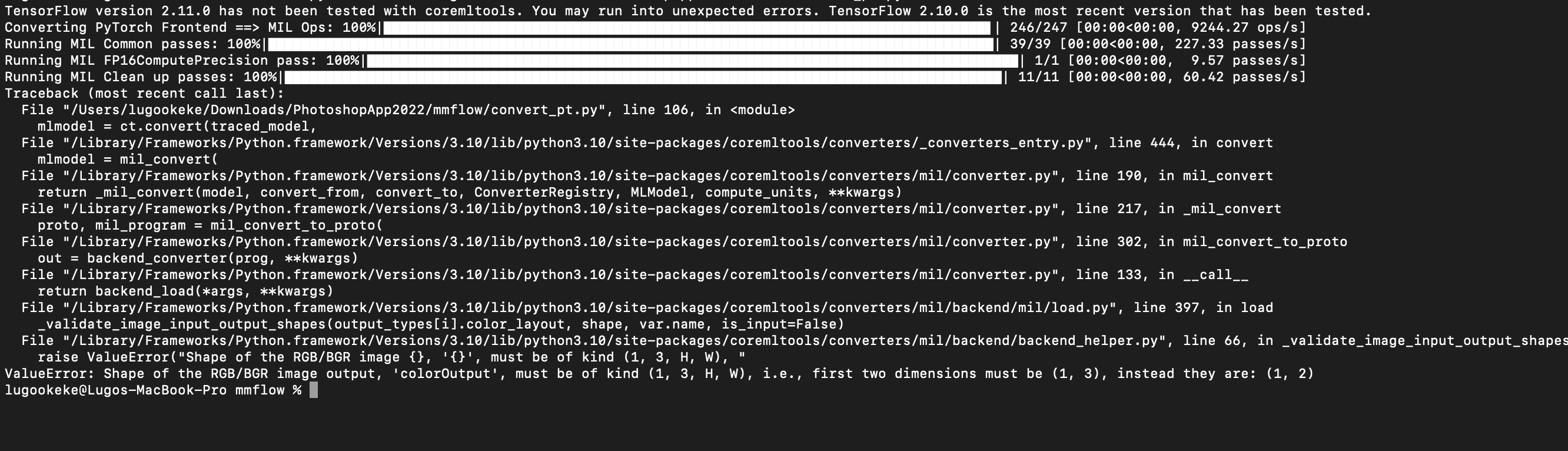
ValueError: Shape of the RGB/BGR image output, 'colorOutput', must be of kind (1, 3, H, W), i.e., first two dimensions must be (1, 3), instead they are: (1, 2)
- Dominant language
- Python
- Stars
- 5.4k
- Forks
- 850
- Avg merge
- 4d 5h
- Merged PRs (30d)
- 10
Description
## ❓Question
I specifically give in a shape of (1, 3, 1024, 1024) but for some reason, Core ML thinks it 2 channels instead of 3.
```python
from torch import nn
def fill_up_weights(up):
w = up.weight.data
f = math.ceil(w.size(2) / 2)
c = (2 * f - 1 - f % 2) / (2. * f)
for i in range(w.size(2)):
for j in range(w.size(3)):
w[0, 0, i, j] = \
(1 - math.fabs(i / f - c)) * (1 - math.fabs(j / f - c))
for c in range(1, w.size(0)):
w[c, 0, :, :] = w[0, 0, :, :]
class DRNSeg(nn.Module):
def __init__(self):
super(DRNSeg, self).__init__()
classes=2
pretrained_drn=None
pretrained_model=None
use_torch_up=False
model = drn_c_26(pretrained=pretrained_drn)
self.base = nn.Sequential(*list(model.children())[:-2])
if pretrained_model:
self.load_pretrained(pretrained_model)
self.seg = nn.Conv2d(model.out_dim, classes,
kernel_size=1, bias=True)
m = self.seg
n = m.kernel_size[0] * m.kernel_size[1] * m.out_channels
m.weight.data.normal_(0, math.sqrt(2. / n))
m.bias.data.zero_()
if use_torch_up:
self.up = nn.UpsamplingBilinear2d(scale_factor=8)
else:
up = nn.ConvTranspose2d(classes, classes, 16, stride=8, padding=4,
output_padding=0, groups=classes,
bias=False)
fill_up_weights(up)
up.weight.requires_grad = False
self.up = up
def forward(self, x):
x = self.base(x)
x = self.seg(x)
y = self.up(x)
return y
def optim_parameters(self, memo=None):
for param in self.base.parameters():
yield param
for param in self.seg.parameters():
yield param
def load_pretrained(self, pretrained_model):
print("loading the pretrained drn model from %s" % pretrained_model)
state_dict = torch.load(pretrained_model, map_location='cpu')
if hasattr(state_dict, '_metadata'):
del state_dict._metadata
# filter out unnecessary keys
pretrained_dict = state_dict['model']
pretrained_dict = {k[5:]: v for k, v in pretrained_dict.items() if k.split('.')[0] == 'base'}
# load the pretrained state dict
self.base.load_state_dict(pretrained_dict)
#img = read_image('test.jpg')
model_path = ("modelphotoshop.pth")
device = 'cpu'
model_flow = DRNSeg()
model_flow.load_state_dict(torch.load(model_path, map_location=device))
model_flow.to(device)
model_flow.eval()
example_input = torch.randn([1,3,1024,1024])
traced_model = torch.jit.trace(model_flow, example_input)
traced_model.save("modelphotoshop.pt")
shape = (1,3, 1024, 1024)
mlmodel = ct.convert(traced_model,
convert_to="mlprogram",
inputs=[ct.ImageType(name="colorImage",
shape=shape,
color_layout=ct.colorlayout.RGB,)],
outputs=[ct.ImageType(name="colorOutput",
color_layout=ct.colorlayout.RGB,)],
)
mlmodel.save("Model.mlmodel")
```
Contributor guide
Research direction
Start at the supplied DRNSeg model and the ct.convert call, tracing the model with the shown input and inspecting the output shape before conversion. Compare that shape with the RGB colorOutput ImageType declaration and review the conversion behavior for this output. Done means the example has a consistent output declaration and a reproducible conversion result.
Written by the indexing model from the issue text.
Assessment
- Tech stack
- python, pytorch
- Domain
- machine-learning, tooling
- Issue type
- Bug
- Difficulty
- 4/5
- Estimated time
- 3-5 days
- Activity status
- Stale
- Clarity
- Needs clarification
- Newbie friendliness
- 35/100