PIP-255: Support for Idempotent Commit and Abort.
- Dominant language
- Java
- Stars
- 15.3k
- Forks
- 3.8k
- Avg merge
- 1d 14h
- Merged PRs (30d)
- 160
Description
## Motivation
- Message queues such as Kafka and Pulsar can only guarantee the exactly-once semantics provided by the transaction feature under **the specific use scenario of `consume-transform-produce` pattern**, that is, a transaction contains both production and consumption.
The operations in the transaction include the production on the sink side and the offset submission on the source side.
Using the atomicity of the transaction, these two operations are either completed at the same time or not completed at the same time. It does not need to worry about whether the transaction is committed successfully, because regardless of whether it is successful or not, the end-to-end state is consistent before and after. Therefore, transaction feature implemented by Kafka and Pulsar only support commit or abort once, and it is illegal to repeatedly submit commit or abort requests afterwards, that is, **they do not support the idempotence of commit operations**.
- But in many other use cases, which is different from `consume-transform-produce` pattern, we need to know the accurate state of the transaction after the commit operation is submitted. For example,
- In the case of `produce-only`, the transaction only contains the production operation, and the offset submission operation is not included, **which is simillar to RocketMQ.**
- The exactly-once semantics guaranteed by Flink is based on the `Two-Phase Commit` protocol implemented by Flink itself. When connecting to an external system, Flink has requirements for external system to ensure the exact once semantics:
1. Provide transaction functionality
2. The transaction commit operation should **ensure idempotence**.
The details can be found in the following link:
https://www.ververica.com/blog/end-to-end-exactly-once-processing-apache-flink-apache-kafka
- Though Kafka do not support for idempotence of commit operations, but Flink-Kafka-Connector do some tricks to achieve the **idempotence of commit operations for the last transaction**, so that Flink+Kafka can guarantee the exactly-once semantics in most of the cases, but still with some risks.
- But for Pulsar, it is impossible to achieve any idempotence of commit operations currently, because the implementation of transaction in pulsar is quite different from kafka. I have post a blog to analyze the difference between Pulsar and Kafka. https://blog.csdn.net/m0_43406494/article/details/130344399
- **Conclusion: Without the idempotence of commit operations, we cannot shift the services from Flink+Kafka to Flink+Pulsar.**
## Analysis
The main challenge to make commit and abort operation idempotent is that, **broker will remove txnMeta from `txnMetaMap` as soon as the transaction is committed or aborted successfully**. As there are multiple commit/abort requests trigger by client or broker itself due to transaction time out, the latter request will meet `TransactionNotFound` exception because broker do not hold the `txnMeta` corresponding transaction.
## Goal
- Provide the idempotence of commit operations for the transaction in Pulsar, which is disabled by default.
- We will introduce a `TransactionMetadataPreserver` to store the terminated transaction metadata which is a component of TC.
- Once we catch the `TrsansactionNotFound` exception, we will query the `TransactionMetadataPreserver` to know the state of the transaction.
- Client will attach the `clientName` to the transaction, and `TransactionMetadataPreserver` will preserve `TransactionMetaPersistCount` number of transaction metadata for each client.
## API Changes
- wire protocol change
```
message CommandNewTxn {
required uint64 request_id = 1;
optional uint64 txn_ttl_seconds = 2 [default = 0];
optional uint64 tc_id = 3 [default = 0];
**optional string client_name = 4;**
}
message CommandEndTxn {
required uint64 request_id = 1;
optional uint64 txnid_least_bits = 2 [default = 0];
optional uint64 txnid_most_bits = 3 [default = 0];
optional TxnAction txn_action = 4;
**optional string client_name = 5;**
}
message TransactionMetadataEntry {
...
**optional string clientName = 13;**
}
enum ServerError {
...
**TransactionPreserverClosed = 26; // Transaction metadata preserver is closed**
}
```
- client configuration change
```
@ApiModelProperty(
name = "clientName",
value = "Client name that is used to save transaction metadata."
)
private String clientName;
```
- broker configuration change
```
@FieldContext(
category = CATEGORY_TRANSACTION,
doc = "Max number of txnMeta of aborted transaction to persist in each TC."
+ "If the number of terminated transaction is greater than this value, the oldest terminated transaction will be "
+ "removed from the cache and persisted in the store."
+ "default value is 0, disable persistence of terminated transaction."
)
private int TransactionMetaPersistCount = 0;
@FieldContext(
category = CATEGORY_TRANSACTION,
doc = "Time in hour to persist the transaction metadata in TransactionMetadataPreserver."
)
private long TransactionMetaPersistTimeInHour = 72;
@FieldContext(
category = CATEGORY_TRANSACTION,
doc = "Interval in seconds to check the expired transaction metadata in TransactionMetadataPreserver."
)
private long TransactionMetaExpireCheckIntervalInSecond = 300;
```
## Implementation
Design Documents in Chinese:
https://blog.csdn.net/m0_43406494/article/details/130350491
- Each `TransactionMetadataPreserver` maintains a `Map`, which maintains the status of the latest `TransactionMetaPersistCount` transactions for each client. Before the transaction ends, the transaction metadata is appended to this List and writed to a compacted topic (persistent://pulsar/system/__terminated_txn_state_${TCid}), the key of the compacted topic is `ClientName`, so the old transaction metadata can be automatically compacted.
- Restore the maintained transaction status information from the compacted topic during TC recovery, which won't take too long time.
- To avoid that some transaction metadata of discarded `clientName` are retained in memory forever, a timer task is initiated to clear the expired transaction metadata in memory. The expiration time is `TransactionMetaPersistTimeInHour` hours. The timer task is executed every `TransactionMetaExpireCheckIntervalInSecond` seconds.
- The creation of topic `__ terminated_ txn_ state_${TCid}` utilizes the topic automatic creation mechanism, so the number of partitions and whether they are partition topics are determined by the configuration corresponding to `broker.conf`. `persistent://pulsar/system/__terminated_txn_state_${TCid}` is a system topic, and the compaction mechanism is forcibly enabled by default.
- The entire logical chain is as follows: **`OPEN status -> writing the aborting log entry to tc log -> updating status to Aborting in memory -> append metadata to TransactionMetaPreserver -> sending endTransaction command to TB,TP -> flush metadata to __terminated_txn_state_${TCid} -> Write aborted log entry to tc log -> Update status to Aborted in memory`**.
Each step of the entire logical chain is idempotent, so it can be guaranteed to be idempotent.
- The reason why we split the operation of preserve terminated transaction metadata into `append` and `flush`?
- To compress the message sent to `__ terminated_ txn_ state_${TCid}`.
- For example, `append txn1 -> append txn2 -> flush txn1 -> flush txn2(No need to flush)`. If we do not split the operation, we will send `txn1, txn2` to `__ terminated_ txn_ state_${TCid}` twice, which is not necessary.
- In my experiment, the compression ratio is about 1/4~2/3, so it is necessary to split the operation.
- Ensure `flush metadata to __terminated_txn_state_${TCid}` is before `Write aborted log entry to tc log`. If the order is reversed, the transaction metadata may be lost. For example, if the broker is shutdown after `Write aborted log entry to tc log` and before `flush metadata to __terminated_txn_state_${TCid}`, the transaction metadata will not be persisted in `__terminated_txn_state_${TCid}`.
- As `flush metadata to __terminated_txn_state_${TCid}` is before `Update status to Aborted in memory`, the transaction written to `__ terminated_ txn_ state_${TCid}` is of `Aborting` state, we should consider `Aborting` equivalent to `Aborted` in `TransactionMetadataPreserver`.
- As the `append`, `flush` methods are executed in the single thread pool in the `MLTransactionMetadataStore`, the implementation of `TransactionMetadataPreserver` does not require concurrency control.
- After the command sent to tb/tp has been successfully executed, we will remove the partitions metadata from `TransactionImpl` to save memory, which takes up most of the memory.
- Further optimization can be achieved by retaining only the aborted transaction metadata and not the committed transaction metadata. If the transaction metadata cannot be found in memory, it is considered to be a committed transaction by default. But in this way, the risk of losing data may be hidden, so **it is not adopted temporarily**. Even worse, users may not be aware of the actual capabilities that Pulsar can provide, and may complain about why Pulsar does not warn users when a loss occurs, which is unacceptable. But technically, this optimization can greatly relieve the pressure on the memory of the broker, as most of the transactions are committed.
## Reject Alternatives
### ~~Solution 1: persist txnMeta for `transactionTimeout` time.~~
The straightforward solution is to persist the txnMeta for `transactionTimeout` time. Every transaction has the property of `transactionTimeout` configured by client, after which the transaction in `OPEN` status will be set to `TIME_OUT`, and TC will try to abort the transaction actively.
If TC persist txnMeta for `transactionTimeout` time, in other words, TC do not remove txnMeta from txnMetaMap as soon as the transaction is committed or aborted, then TC can query the transaction status for subsequent commit/abort request based on txnMetaMap, which could resolve the problem.
We could analyze solution1 deeper.
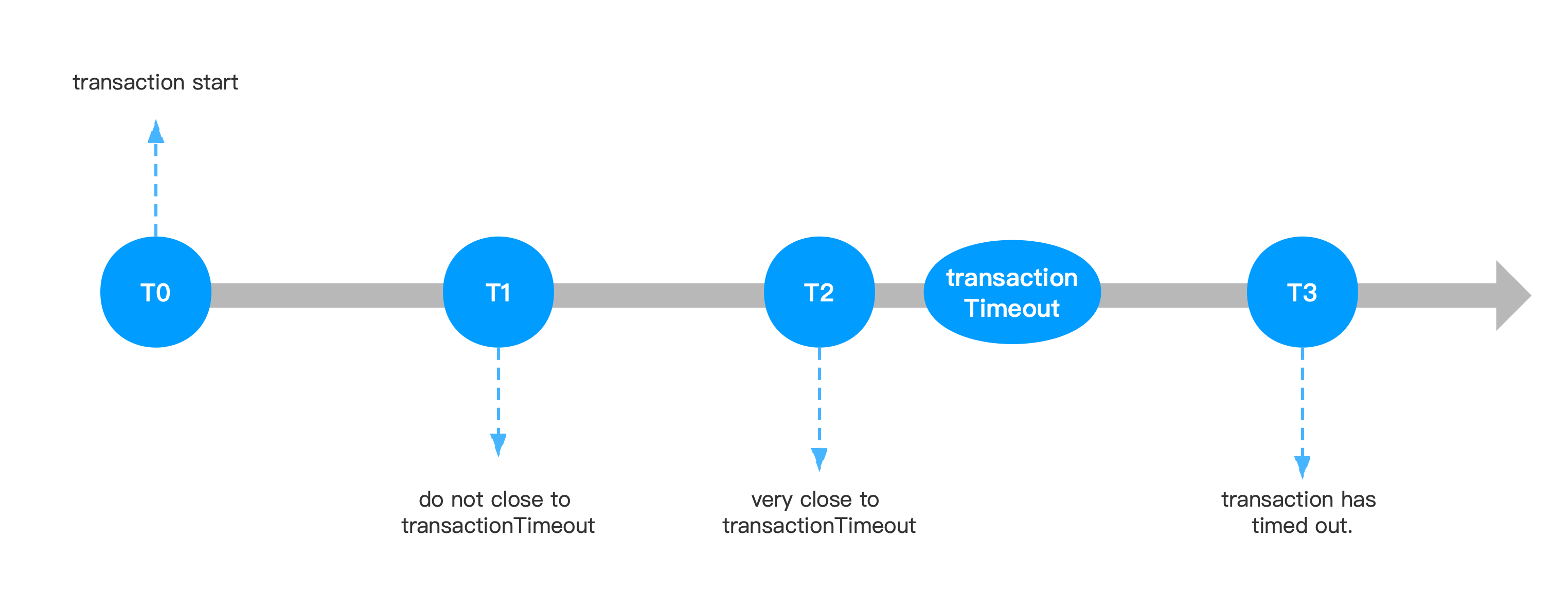
Client start transaction `txn1` at T0, and may issue multiple commit/abort requests at T1, T2, T3. T1 is not close to `transactionTimeout`, while T2 is close to `transactionTimeout`. T3 is greater than the `transactionTimeout`.
- If client try to commit/abort at T3 for the first time, it cannot issue the commit request as the transaction has timed out.
- If client try to commit/abort at T1 for the first time, client will receive correct response and set the transaction status to `COMMITTED` or `ABORTED`. As a result, the subsequent commit/abort request will be discarded by client because client know that the transaction `txn1` has been `COMMITTED` or `ABORTED`.
- If client try to commit/abort at T2 for the first time, client could issue the commit request `req1` to TC as the transaction do not time out yet. When the request come to TC, `txn1` may be timed out as T2 is very very close to `transactionTimeout`. As a result, TC try to abort `txn1` actively ( called `req2` ) and there will be two concurrent commit/abort process `req1` and `req2`.
- If `req1` is faster than `req2`, then client will commit successfully.
- If `req2` is faster than `req1`, then TC will abort `txn1` and remove txnMeta from `txnMetaMap` instantly, which result into that the subsequent request `req1` fail with `TransactioinNotFound`. Though client receive the exception, the consistence of transaction can still be guaranteed as `txn1` is aborted in TC and client consider `txn1` commit failed.
#### Disadvantages:
- The persistence of transaction metadata is achieved by TC logs. If the metadata is not deleted immediately when the transaction is completed, the deletion all the tc log entries corresponding to the transaction will be delayed for a long time. If the transaction timeout is set to 1h, then the tc log entries produced in 1h will be scanned during TC recovery, which will greatly lengthen the TC recovery time and cause a long unavailable time.
- If the transaction concurrency suddenly increases and the transaction timeout time does not change, the memory size occupied by transaction metadata may suddenly increase, causing frequent GC or even OOM error, which is uncontrollable. Because as the time goes by, the transaction concurrency continue to increase, and the memory usage issues will become increasingly prominent.
Though solution1 has been implemented first, it is not a good solution. We do not adopt it finally.
If interested, you can refer to the following PR:
https://github.com/apache/pulsar/pull/19662
Contributor guide
Research direction
Start with the Goal, API Changes, and Implementation sections, then review the linked design document and the transaction-coordinator and metadata-preserver behavior it describes. The issue names no source files or tests; done means the proposed protocol and configuration changes support idempotent commit and abort, including recovery and append/flush ordering.
Written by the indexing model from the issue text.
Assessment
- Tech stack
- java, kafka
- Domain
- backend-api-design, distributed-systems
- Issue type
- Feature
- Difficulty
- 5/5
- Estimated time
- Over a week
- Activity status
- Stale
- Clarity
- Mostly clear
- Newbie friendliness
- 25/100