Rework `PinotByteBuffer` to allow batch operations
- Dominant language
- Java
- Stars
- 6.1k
- Forks
- 1.5k
- Avg merge
- 2d 3h
- Merged PRs (30d)
- 195
Description
Aggregation performance appears to be bottlenecked on `DirectByteBuffer` bounds checks, as can be seen in this profile taken from a pinot server in a live system executing group by queries (among other things) - nearly 30% of samples were in `Buffer.checkIndex`.

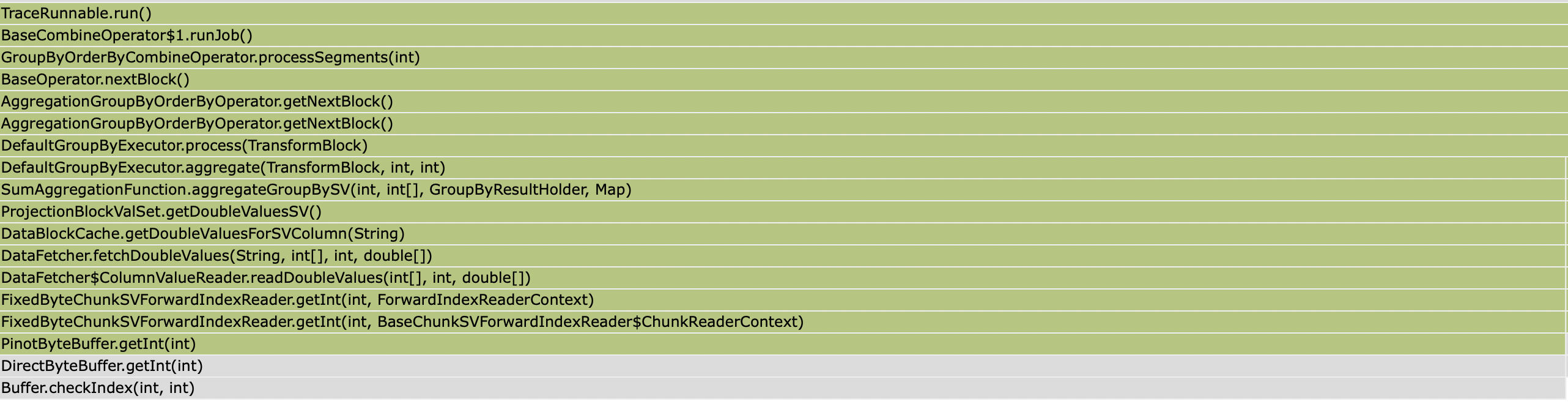
These checks can usually be eliminated when the accesses are sequential, e.g. within a counted loop with a known bound. #7708 produced a ~5x speedup be reducing the number of accesses to `PinotDataBuffer` by a factor of 8, but a more general technique applicable to aggregations would be to pass a primitive array to be filled in a for loop, rather than assume `PinotDataBuffer.getX` calls behave like array accesses. This would have to support the Cartesian product of numeric types to support some of the conversions we need (e.g. `int` to `double`)
Contributor guide
Research direction
Start by tracing PinotByteBuffer and PinotDataBuffer accesses in aggregation code, then review the bounds-check profile and the approach from #7708. Determine the batch API and numeric-type conversions needed for sequential reads. Done means aggregations can use batch operations without the current per-access bounds-check bottleneck.
Written by the indexing model from the issue text.
Assessment
- Tech stack
- java
- Domain
- databases, performance
- Issue type
- Refactor
- Difficulty
- 5/5
- Estimated time
- Over a week
- Activity status
- Stale
- Clarity
- Needs clarification
- Newbie friendliness
- 25/100