[pyarrow] Regarding performance issue of filter operation
- Dominant language
- C++
- Stars
- 17.1k
- Forks
- 4.3k
- Avg merge
- 3d 13h
- Merged PRs (30d)
- 88
Description
Hi,
It seems like the compute method, filter() has some performance issue, when the number of True values are very small in the input mask in comparison to the number of false values. It is even slower than pandas dataframe filter operation.
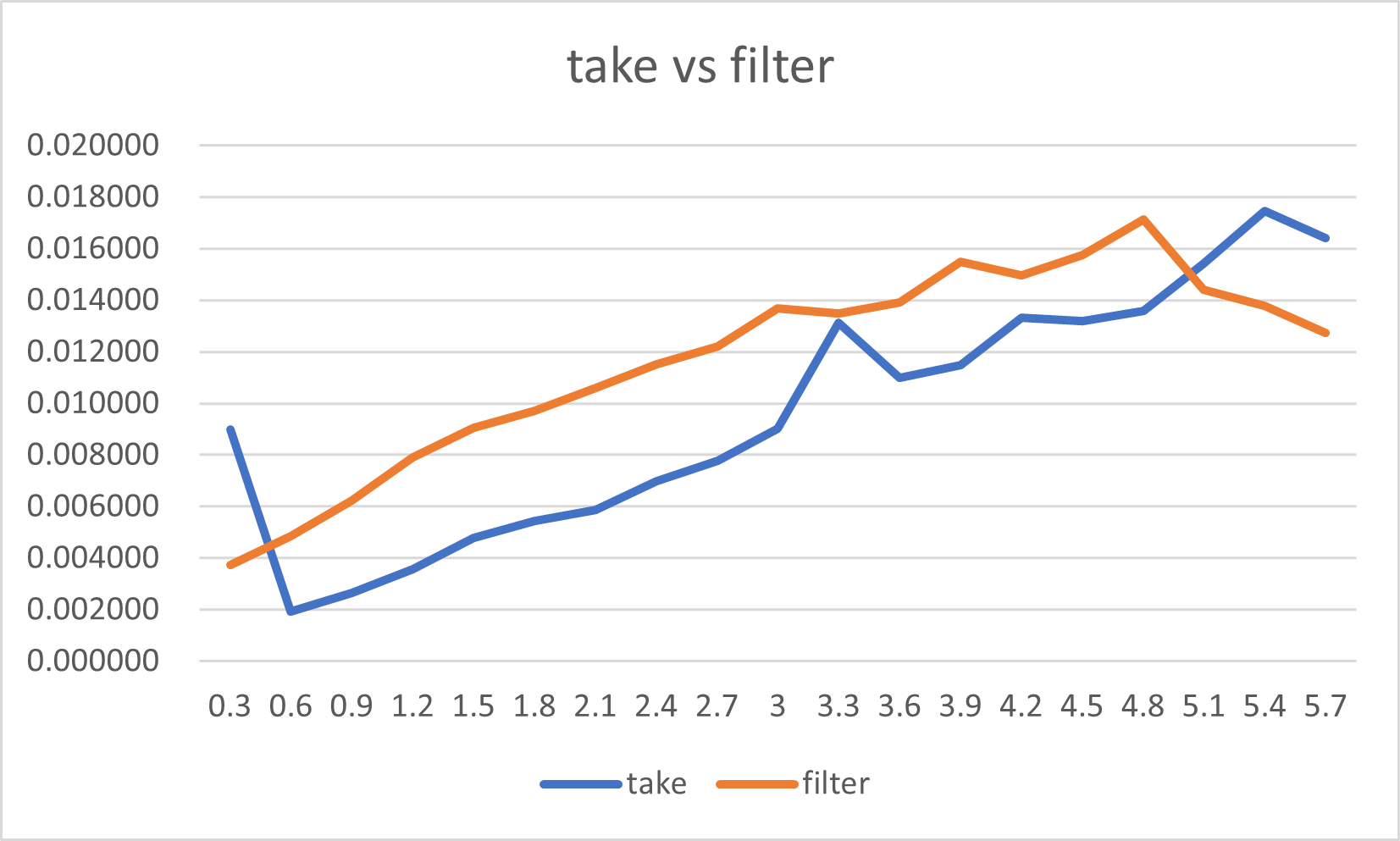
Although filter() is slower, but the take() method seems to have better performance for those cases.
Please consider the following experiemental code:
---
import time
import math
import numpy as np
import pyarrow as pa
parr = pa.array(range(6161464))
def get_pos(N, per):
tot = math.ceil(N * per)
step = N // tot
ret = []
for i in range(0, N, step):
ret.append(i)
return ret
def eval(N):
pers = [i * 0.003 for i in range(1, 30)]
for i in pers:
per = round(i * 100, 2)
indx = get_pos(N, i)
stime = time.time()
ret = parr.take(indx)
print("[per: {}%] pyarrow take time: {} sec".format(per, time.time() - stime))
mask = np.asarray([False] * N)
mask[indx] = True
pa_mask = pa.array(mask)
stime = time.time()
ret = parr.filter(pa_mask)
print("[per: {}%] pyarrow filter time: {} sec".format(per, time.time() - stime))
eval(6161464)
The take() method is significantly faster for the distribution of True values less than 5.1% in the input mask.
Filter starts showing better performance when the "True"-distribution exceeds 5.1%.
Filter is a very frequently used method and having lesser True values is somewhat very common in data preprocessing.
Thus it would be really great if the perfiormance issue of Filter() can be checked and improved.
Thanks,
Sourav
Contributor guide
Research direction
No files or tests are named. Reproduce the supplied Python benchmark comparing pyarrow take() and filter() with sparse masks, then trace the compute filter() entry point and its implementation; done means improved performance for low True-density masks without regressing dense-mask behavior.
Written by the indexing model from the issue text.
Assessment
- Tech stack
- cpp, numpy, pandas, python
- Domain
- data, performance
- Issue type
- Bug
- Difficulty
- 4/5
- Estimated time
- 3-5 days
- Activity status
- Stale
- Clarity
- Needs clarification
- Newbie friendliness
- 35/100