QuantumBFS / QuantumBFS/quantum.harness
[challenge]: Advantage or artifact? Hunt on the Quantum Advantage Tracker
Nobody has claimed this yet.
- Dominant language
- Python
- Stars
- 66
- Forks
- 93
- PR merge metrics
- No merged PRs in 30d
Description
Released by
Lei Wang (王磊), Institute of Physics, Chinese Academy of Sciences
Contact email
wangleiphy@gmail.com
Method
Classical simulation / variational methods / quantum advantage benchmarking
Challenge issue
Advantage or artifact? Hunt on the Quantum Advantage Tracker
Track: classical simulation · quantum computing · agentic verification
Difficulty: a ladder — the first rung is an afternoon, the top rung is open research
Compute: a laptop is enough to start and has cracked frontier problems before; a workstation or cluster helps
Deliverable: reproducible energies, observable estimates, or samples — submitted for public peer review on a live community tracker
Every few months a paper announces that a quantum computer has done something no classical computer can match. Some of these claims have held up. Others were overturned within weeks by a better classical algorithm — occasionally by one running on a laptop. Each claim is a falsifiable scientific hypothesis, and the interesting question is never "is quantum advantage real in principle?" but "does this specific claim, on this specific problem instance, survive contact with the best classical methods we can build?"
The Quantum Advantage Tracker is where that question is now being settled in public. It is a community-run scoreboard — built by researchers from more than fifteen organizations, including IBM, RIKEN, Caltech, and the Flatiron Institute — that turns each advantage claim into a concrete, downloadable problem instance (a quantum circuit in QASM, or a Hamiltonian in FCIDUMP format), collects competing quantum and classical results, and reviews every submission openly on GitHub. Each instance carries one of three labels, and the labels move:
- Active candidate — quantum computations currently appear to challenge the best classical methods; the case is open.
- Superseded candidate — quantum once appeared ahead, but classical progress closed or reversed the gap.
- Baseline benchmark — a reference point where the state of the art is classical.
Your mission: learn the ecosystem from the inside — warm up on baseline problems, then pick any active candidate you like and attack it. This challenge is deliberately open-ended. The tracker has three pathways with very different flavors, and part of the exercise is choosing the hunt that fits your skills and taste.
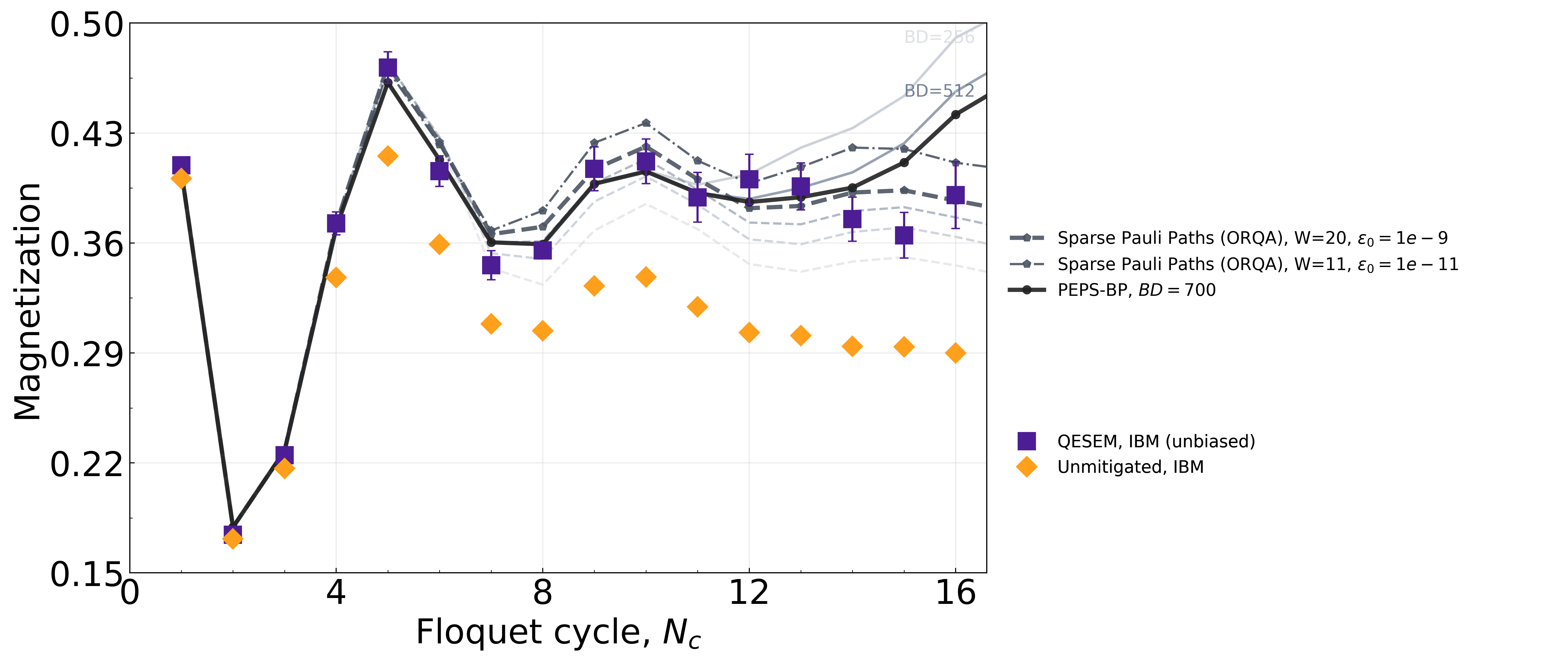
The whole game in one picture: the magnetization of a 51-qubit, 16-cycle Floquet Ising circuit, as estimated by error-mitigated IBM hardware (purple squares, with error bars), unmitigated hardware (orange), and several classical methods — a belief-propagation tensor network and sparse Pauli path propagation at various truncations (black and gray curves). At late cycles the estimates fan out beyond their quoted uncertainties. Someone is wrong. Finding out who is the game. Figure from the tracker repository.
The three pathways
1. Observable estimations. You are given a circuit and an observable; you report an expectation value with a defensible error bar. There is no exact answer to look up — confidence comes from convergence studies and agreement across independent methods, which is exactly what makes these the deepest waters. Current active candidates: the Floquet mixed-field Ising circuits above (51 and 74 qubits on a heavy-hexagon lattice, up to 30 cycles; magnetization and two-point correlators), the operator Loschmidt echo family (49 to 70 qubits — an out-of-time-order-correlator-like probe of operator spreading), and SU(2) lattice gauge theory hadron dynamics in the loop-string-hadron encoding (60 sites, 120 qubits, 20 Trotter steps — where the submitters' own benchmark table shows the quantum processor answering in 20 seconds against roughly 2500 to 9000 seconds for their tensor-network and Pauli-propagation baselines).
2. Variational problems. You are given a Hamiltonian; you report a variational upper bound on its ground-state energy, with evidence the bound is genuine. This is the cleanest pathway — like the Lennard-Jones record book of our sibling challenge #117, a variational energy is a one-line, machine-checkable claim, and lower always wins. The five systems are an N₂ dissociation curve (14 electrons, 28 orbitals, nine bond lengths), the [2Fe-2S] and [4Fe-4S] iron-sulfur clusters from biochemistry (30 electrons in 20 orbitals, and 54 electrons in 36 orbitals), a four-impurity Anderson model with 28 bath orbitals (the workhorse Hamiltonian of correlated-materials simulation), and a synthetic 49-qubit "guided sparse ground state" problem. Every one is currently a classical-led baseline — the standing invitation is to push the records lower and to punish any quantum entry that overclaims.
3. Classically verifiable problems. You are given a task whose answer can be checked cheaply even though finding it appears hard. The active candidates are two 98-qubit peaked circuits — circuits engineered so that one secret bitstring is overwhelmingly more likely than all others (construction paper); find the bitstring and the check is one line — and a 70-qubit random graph state sampling instance at CZ-depth 70 with 27 error-detecting ancilla qubits, a verifiable descendant of the random-circuit-sampling experiments (sampling random regular graph states is average-case #P-hard). This is treasure hunting with a built-in gold detector.
Records move — recent case files
The tracker's short history already contains the full life cycle, and it sets the tone for what a student can realistically do:
- Three peaked circuits fell. Instances at 49 and 56 qubits went from active to superseded when classical tensor-network methods extracted the hidden bitstring — one of the winning entries, a matrix-product-operator simulation, ran on an ordinary CPU laptop. The two 98-qubit instances are the survivors. History suggests they are not safe.
- The iron-sulfur arms race. On the [4Fe-4S] cluster, a quantum-centric sample-based diagonalization by IBM and RIKEN — using a Heron processor together with 76,032 nodes of the Fugaku supercomputer — reported a variational energy of −326.913 hartree. Within days, entries from a classical configuration-interaction code (TrimCI, University of Wisconsin–Madison) matched that number in fifteen minutes on a 20-core Apple M1 Ultra desktop chip, and then pushed the record to −327.175 on a modest cluster. The ladder now reads: Hartree-Fock −326.547, CISD −326.742, quantum SQD −326.913, classical TrimCI −327.175. Your move.
- A soft spot nobody has claimed. The Anderson impurity model instance (4 impurities on a square plaquette with Hubbard repulsion U = 10, hopping t = −1 and t′ = −0.5, 7 bath orbitals per impurity with a semicircular hybridization — 32 orbitals and 32 electrons in all) has exactly one entry: a quantum-centric result at −62.2567. No classical method has submitted at all. An impurity-plus-bath Hamiltonian is quasi-one-dimensional in a star or chain geometry, which is home terrain for the density-matrix renormalization group. This record is soft, and it is sitting in plain view.
The ladder — warm up on baselines, then hunt actives
As with the Lennard-Jones bounty (#117), every rung produces a measurable result, so there is no such thing as a wasted run.
- Rung 0 — Plug in (an afternoon). Pick a pathway. Download one instance and reproduce a known number. Variational: read the 4Fe-4S FCIDUMP into PySCF and reproduce the Hartree-Fock entry, −326.5474 hartree. Observable: simulate the smallest operator Loschmidt echo circuit (the 49-qubit instance labeled 49x648 — a baseline with published classical entries to compare against). Verifiable: rerun one of the three superseded peaked circuits and recover its now-public bitstring. Score: you match the recorded numbers; you now speak the tracker's file formats.
- Rung 1 — Sharpen your weapon on a baseline. Take one baseline problem and push it toward the state of the art with a classical method of your choice — density-matrix renormalization group, neural quantum states, selected configuration interaction, tensor networks, Pauli propagation. Concrete practice targets: beat the CISD entry (−326.742) on 4Fe-4S; converge the 2Fe-2S cluster, whose Hilbert space of about 2×10⁸ determinants is within reach of near-exact methods against the standing −116.6054; trace the N₂ curve into the strongly correlated dissociation regime. Score: your energy versus the leaderboard — every improvement is submittable.
- Rung 2 — Attack an active candidate. Choose your prey anywhere on the board: tighten the classical error bars on the 51- or 74-qubit Floquet Ising observables until the disagreement in the figure above is resolved; run Pauli propagation or tensor networks on the 120-qubit SU(2) hadron dynamics; hunt the hidden bitstring of a 98-qubit peaked circuit; or be the first classical entry on the Anderson impurity model. Matching a quantum entry is worth points; beating one, or resolving a discrepancy with defensible error bars, is a catch. Score: your number, your bound, or your bitstring — plus the evidence.
- Rung 3 — Ship it. Write your result up to the tracker's standard (a one-page-plus summary of method and evidence, resource and runtime details, code or paper link — see the participation guide) and submit it through a GitHub issue. Independent reviewers will engage with it in the open. Score: an accepted entry with your name on a public scientific scoreboard — and if your classical result overturns an active candidate, you will have moved a label the whole field watches.
How not to fool yourself
The tracker exists because self-deception is the default state of this field, on both sides. House rules, in the same spirit as the verification gates of #117:
- Variational means variational. An energy claim must be a true upper bound from a normalized state, reproducible from your submitted description. No extrapolated-only numbers dressed up as bounds; if you extrapolate, label the extrapolation.
- An error bar is a promise. For observable estimates, report how the error bar was obtained (truncation scans, bond-dimension or weight extrapolation, statistical resampling) and show the convergence evidence. A small error bar you cannot defend is worse than a large one you can.
- Reproduce before you announce. Cross-check with a second, independent method or implementation before claiming a catch — the same discipline that separates a record from a typo (veterans of #117 will remember the N = 447 lesson).
- Publish the negative audits. If the active candidate survives your best attack, submit the audit anyway. Hardening a quantum advantage claim by failing to break it honestly is a contribution to physics, not a consolation prize.
Why this may lead to research output
Every layer of this challenge touches live research. Superseding an active candidate is, on recent evidence, a publishable event — the peaked-circuit and iron-sulfur case files above each correspond to real entries filed within the last year, several with papers attached. First classical entries on unclaimed instances (the Anderson impurity model is waiting) are clean, citable results. And beyond individual catches, the tracker itself is the field's experiment in refereeing its most contested question — by participating, a student learns state-of-the-art simulation methods and the machinery of adversarial scientific verification at the same time, which is precisely the agentic-verification theme of this school. The deliverable could not be more concrete: a number, a bound, or a bitstring, with your name next to it, that anyone in the world can check.
References
- Quantum Advantage Tracker: site · how to participate · GitHub repository and public review · submission templates
- Problem instance data: observable estimations · variational Hamiltonians · classically verifiable circuits
- Peaked circuits: "Heuristic Quantum Advantage with Peaked Circuits." arXiv:2510.25838
- Hardness of graph-state sampling: "Random regular graph states are complex at almost any depth." arXiv:2412.07058; the ancestor experiment is random circuit sampling: "Quantum supremacy using a programmable superconducting processor," Arute et al., Nature 574, 505 (2019)
- Operator Loschmidt echo: Algorithmiq model description and theory
- Iron-sulfur cluster provenance: "Low-energy spectrum of iron–sulfur clusters directly from many-particle quantum mechanics," Nature Chemistry (2014); active spaces from "Spin-Projected Matrix Product States," J. Chem. Theory Comput. (2017)
- Sibling challenge in this school: the Lennard-Jones cluster bounty hunt, #117
Contributor guide
No contributing guide indexed for this repository
First steps
- Read the whole issue, then the project's contributing guide.
- Comment on the issue to say you are picking it up — it saves two people doing the same work.
- Fork the repository and make your change on a branch.
- Open a pull request that references the issue number.
Research direction
Choose one of the three pathways and start by downloading an instance from the linked Quantum Advantage Tracker repository. Use the participation guide and reproduce a published baseline, such as the 4Fe-4S Hartree-Fock value with PySCF. Done means a reproducible energy, observable estimate, or bitstring with supporting evidence submitted through a tracker GitHub issue.
Written by the indexing model from the issue text.
Assessment
- Tech stack
- python
- Domain
- documentation
- Issue type
- Feature
- Difficulty
- 5/5
- Estimated time
- Over a week
- Activity status
- Quiet
- Clarity
- Needs clarification
- Newbie friendliness
- 25/100