QuantumBFS / QuantumBFS/quantum.harness
[challenge]: How low can you go? A bounty hunt for record-beating Lennard-Jones clusters
Nobody has claimed this yet.
- Dominant language
- Python
- Stars
- 66
- Forks
- 93
- PR merge metrics
- No merged PRs in 30d
Description
Released by
Lei Wang (王磊), Institute of Physics, Chinese Academy of Sciences
Contact email
wangleiphy@gmail.com
Method
Global optimization / basin-hopping
Challenge issue
How low can you go? A bounty hunt for record-beating Lennard-Jones clusters
Track: global optimization · energy landscapes · agentic verification
Difficulty: intermediate — anyone can start in an afternoon; the frontier is genuinely hard
Compute: a laptop is enough to play; a workstation or a night on the cluster helps for big clusters
Deliverable: machine-verified configurations and a growing public leaderboard of "catches"
There is a table of numbers that has quietly resisted the world's best optimization algorithms for thirty years. For each cluster of N atoms held together by the simplest interaction in physics — the Lennard-Jones pair potential — it lists the lowest energy anyone has ever managed to find. These are the putative global minima of the Lennard-Jones clusters, and putative is the load-bearing word. Almost none of them has ever been proven optimal: rigorous certification stops at a handful of atoms (the first proof for the five-atom cluster was itself a publishable result, obtained by interval branch-and-bound; see Vanaret, arXiv:2001.11465, and deterministic certification remains an active frontier today: Kuznetsov & Sahinidis, J. Global Optim. 2025). Everything else in the table is simply the best that decades of basin-hopping, genetic algorithms, and simulated annealing have turned up. It is a record book, not a theorem.
Your mission for the week is a treasure hunt: find a configuration whose energy sits below the current record for a single-component (monoatomic) Lennard-Jones cluster. You get to choose your prey — the size N and the neighborhood of the map. The monoatomic table is the canonical record book of the field, so this is where a catch means the most, and — as the terrain guide below argues — its large-N reaches are far less thoroughly searched than the table's reputation suggests. Only if you convince yourself, with evidence, that your chosen monoatomic seam is truly mined out should you diverge to the softer side quests (binary mixtures, molecular clusters, other pair potentials) listed at the end. The beauty of this challenge is that there is no arguing with success. Unlike most research, where "did it work?" is a judgment call, here the verification is a one-line, rigorous, machine-precision check: you either found gold or you didn't. And even when the record holds — which, honestly, it usually will — every serious attempt produces a measurable, publishable audit of the landscape. There is no such thing as a wasted run.
The system
The Lennard-Jones cluster is the fruit fly of global optimization. N structureless atoms interact through
$$ E = 4\varepsilon \sum_{i \lt j} \left[ \left(\frac{\sigma}{r_{ij}}\right)^{12} - \left(\frac{\sigma}{r_{ij}}\right)^{6} \right], $$
and in reduced units ($\varepsilon = \sigma = 1$, no cutoff, all pairs summed) the ground-state geometry is a pure, parameter-free optimization problem. The catch is brutal: the number of distinct local minima grows roughly exponentially with N — extrapolating Tsai and Jordan's exhaustive enumeration for small clusters suggests the 147-atom cluster already has on the order of $10^{60}$ minima (Wales & Doye 1997) — and the global minimum is a single needle hiding in that haystack. This is exactly why the community adopted LJ clusters as the benchmark for global optimizers: see OptBench's LJ38 / LJ75 / LJ98 / LJ150 entries, whose scoring is literally "how many force evaluations until you hit the known record."
Know the terrain — what the record holders look like
The default motif is icosahedral. For most sizes between roughly 10 and 150 atoms, the global minimum is a fragment of the Mackay icosahedron — an onion of twenty slightly strained face-centered-cubic tetrahedra (Wales & Doye 1997). If you pull a random entry from the tables, it will almost certainly look like one of these:
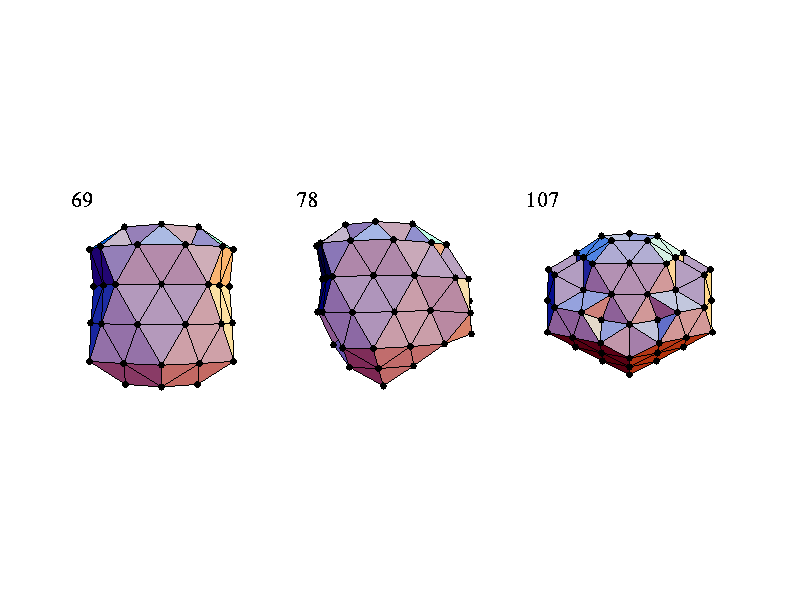
Typical record holders: icosahedral global minima at N = 69, 78 and 107. Image from the Cambridge Cluster Database (Wales group / J. Doye).
The celebrated exceptions are the classic hard cases. At a handful of sizes the true minimum abandons the icosahedral motif, and those sizes became legendary precisely because biased or short searches miss them. LJ38 is a face-centered-cubic truncated octahedron ($O_h$ symmetry, $E = -173.928427$) hiding at the bottom of a narrow funnel, while a broad icosahedral funnel traps almost every search — the famous double-funnel landscape (Doye, Miller & Wales, J. Chem. Phys. 110, 6896 (1999)). LJ75–77 and LJ102–104 are Marks decahedra, which basin-hopping and genetic algorithms were the first unbiased methods to find:

The famous exceptions: the fcc truncated octahedron at N = 38 (top left) and the Marks decahedra at N = 75–77 and 102–104. Image from the Cambridge Cluster Database.
And records really do fall. The current LJ98 minimum is itself a correction: in 1999, after the first databases were published, Leary and Doye discovered a tetrahedral structure lower than the icosahedral incumbent (Leary & Doye, Phys. Rev. E 60, R6320 (1999)):

The record that fell: Leary's tetrahedral LJ98 global minimum (1999), which displaced the previously accepted icosahedral structure. Image from the Cambridge Cluster Database.
Record books also contain plain errors. In 2023 a systematic screen of pooled databases, using a simple necessary condition for optimality (the average pair energy must decrease monotonically with N), flagged the N = 447 entry as non-optimal (Kiessling, J. Chem. Phys. 159, 014301 (2023)). The twist — and a lesson baked into this challenge — is that on inspection the flag turned out to be a transcription typo in the tabulated energy, not a beatable structure: the configuration itself was fine all along (details in Rung 2 below). The map has both genuine gaps and booby traps, and telling them apart is half the skill.
Where the gold is — hunt the monoatomic frontier
Be honest with yourself about the odds, because it changes where you dig. For N up to about 150 the monoatomic table is fortified: thirty years of independent methods converge on the same structures, and unbiased conformational-space-annealing searches reproduced the entire list up to N = 201 (Lee, Lee & Lee). Expecting to beat LJ38 is like expecting to find a twenty-dollar bill on a sidewalk that a million people have already walked. Treat the small sizes as your training ground (Rungs 0–1 below), not your hunting ground.
The place to dig is the large-N monoatomic frontier, where the searches that set the records were far shallower than the table's small-N reputation suggests:
N = 151–309— tables maintained on Xueguang Shao's site, linked from the Cambridge Cluster Database.N = 310–561(table) andN = 562–1000(table) — most of these records date to 2004 and were produced by a genetic algorithm seeded with icosahedral, decahedral, and close-packed lattice constructions (Xiang, Jiang, Cai & Shao, J. Phys. Chem. A 108, 3586 (2004); Xiang, Cheng, Cai & Shao, J. Phys. Chem. A 108, 9516 (2004)). Lattice seeding is powerful, but it is biased: a global minimum lying outside the assumed structural families would have been invisible to it. And the record book in this range has demonstrably budged since first publication — the tables themselves credit later improvements at more than a dozen sizes to Barrón, to Takeuchi, and to Huang, Lai & Xu.N = 1001–1610— the shallowest waters of all. The only gap-free record list here is the pooled data assembled for the 2023 optimality screen, pooled from seventeen different sources.
Three ways to pick your target size inside this frontier:
- Motif crossover regions. At large
Nthe icosahedral, decahedral, and face-centered-cubic families approach each other in energy, and the winner at any particular size is decided by tiny margins — that competition is exactly what the "structural distribution" survey for 562–1000 atoms maps out. Sizes near a motif changeover are where a biased search is most likely to have crowned the wrong family. - Anomalies in the energy sequence. Compute the first differences
E(N) − E(N−1)and the average pair energy along the table. An entry that sits anomalously high relative to a smooth interpolation of its neighbors is a natural suspect — this is the same reasoning behind the necessary-condition screen, applied with a finer comb. - Single-source entries. A record that traces to one group and has never been reproduced by an independent, unbiased search carries much weaker evidence than a record that ten methods have all hit. The reference columns of the tables tell you which is which.
Only if the monoatomic seam runs dry. If, after honest effort and a documented audit, you conclude your chosen monoatomic range offers no room for improvement, there are softer side quests: binary Lennard-Jones mixtures, where two atom sizes make the configuration space combinatorially larger and far less mapped (OptBench's binary benchmark: an A₄₂B₅₈ system at size ratio 1.3, putative minimum −604.796307, is a single studied point in a wide-open parameter plane); molecular clusters such as the TIP4P water systems with their orientational degrees of freedom; and adjacent pair potentials such as the Morse potential at various range parameters, which are less exhaustively catalogued than Lennard-Jones. Catches there still count on the scoreboard — just at side-quest weight.
The hunt — a ladder you can always climb
Progress is measurable at every rung, so you make forward progress whether or not a record falls.
- Rung 0 — Warm up (guaranteed). Implement the LJ energy and forces in reduced units. Pull a known putative minimum from the database (each
Nin the tables links to a Cartesian coordinates file, and a tar archive of all points is available) and reproduce its energy to machine precision. Score:|E_you − E_ref| < 10⁻⁶. This one line catches most "I beat the record!" mistakes before they happen (see the verification plan). - Rung 1 — Sharpen the tools. Run your global optimizer from many random starts on a hard but solved target and rediscover its known minimum. Basin-hopping is the classic starting point (Wales & Doye 1997; the Wales group's GMIN code is a reference implementation); minima-hopping, genetic algorithms, and conformational space annealing are equally fair game. Score: success rate and force evaluations to first hit — directly comparable to the OptBench leaderboards for LJ38 and LJ75.
- Rung 2 — Learn to read a flag (the
N = 447lesson). Run the 2023 necessary-condition screen across a database and reproduce itsN = 447flag: in the pooled list the energy−2292.783729sat impossibly high between its neighbors (−2985.461112atN = 446and−3000.081058atN = 448). Then diagnose it the way Christian Müller did within days of the preprint: recompute the energy of the actual stored configuration and find−2992.783729449165— matching the original 2004 publication. The structure was fine; a single transcribed digit (a 2 where a 9 belonged) had corrupted the record. Score: pass/fail on reaching the right diagnosis. This teaches the single most important reflex in the challenge: a screen failure has two causes, corrupted data and genuine non-optimality, and you must rule out the boring one before you celebrate. - Rung 3 — The hunt (the prize). Choose a monoatomic target from the frontier above, run an independent global search, and either match the incumbent from an unbiased start (already worth points) or beat it (a catch). Score:
ΔE = E_incumbent − E_you, verified.
How progress is measured — the scoreboard
A shared leaderboard makes it competitive and fun. Each row is a claim:
| system | N (composition) | incumbent E | source | your E | ΔE | verified? |
|---|
- A "catch" is any verified
ΔE > 0(you went lower). Catches are weighted by how well-studied the target was — beating any entry of the monoatomic record book would be a headline, with weight increasing toward the well-studied small sizes; improving a binary composition on a side quest is a solid, honest catch at lower weight. - A "match" is rediscovering a hard incumbent from unbiased random starts, scored by efficiency (force calls to first hit), in the style of OptBench.
- An "audit" is a clean systematic screen of a database region (found nothing beatable, or found and fixed a data error). Negative results count — they harden the record book.
Nobody leaves empty-handed: the ladder guarantees a measurable result at Rungs 0–2 even if the frontier holds.
Verification plan — the oracle, and how not to fool yourself
The reason this challenge can be scored so cleanly is that demonstrating an improvement is rigorous and cheap, even though proving optimality is practically impossible. A claimed catch is accepted only if it clears all four gates:
- Exact potential. The energy is recomputed under the reference definition — reduced units, no cutoff, no shift, all pairs. The number one way to produce a fake record is to compare a truncated-potential energy against a full-potential incumbent. Rung 0 exists to close this hole.
- A true minimum, not a saddle. Re-minimize to a tight tolerance (
|force| < 10⁻⁸) and confirm the Hessian is positive definite apart from the six zero modes of overall translation and rotation. A lower "energy" at a saddle point or an unconverged structure is not a competitor. - Independent reproduction. A second, independent minimizer — and restarts from small random perturbations — must return to the same configuration and energy. One-off numbers do not count.
- Necessary-condition sanity. The new configuration must pass the 2023 monotonicity screen against its neighbors, and its energy must be self-consistent across
N−1,N,N+1.
Pre-registered honesty rules: report the incumbent's exact value and source; claim only improvement, never optimality; and publish the negative audits, not just the catches. These are the same disciplines that turned the N = 447 scare into a correctly diagnosed typo instead of a false discovery.
Why this may lead to research output
Confirmed improvements to a public cluster database are a recognized micro-publication genre — the tetrahedral LJ98 correction and the large-N surveys are exactly this, and the Cambridge Cluster Database explicitly solicits improvements ("If you can improve on any of the results given in these pages email me, and I will update the database"). A systematic monoatomic large-N audit with even one genuine catch is a clean, citable result, and the verified negative audits directly harden the community's benchmarks, in the spirit of the agentic-verification challenges already in this school. Best of all, the deliverable is unambiguous: a coordinate file and an energy that anyone can check in one line.
References
- D. J. Wales and J. P. K. Doye, "Global Optimization by Basin-Hopping and the Lowest Energy Structures of Lennard-Jones Clusters Containing up to 110 Atoms," J. Phys. Chem. A 101, 5111 (1997). arXiv:cond-mat/9803344
- The Cambridge Cluster Database (Wales group): LJ cluster pages — tables N = 3–150, N = 310–561, N = 562–1000, pictures; tables for N = 151–309 and 1001–1610 on Xueguang Shao's site
- J. P. K. Doye, M. A. Miller and D. J. Wales, "The double-funnel energy landscape of the 38-atom Lennard-Jones cluster," J. Chem. Phys. 110, 6896 (1999). arXiv:cond-mat/9808265
- R. H. Leary and J. P. K. Doye, "New Tetrahedral Global Minimum for the 98-atom Lennard-Jones Cluster," Phys. Rev. E 60, R6320 (1999). arXiv:cond-mat/9908165
- J. Lee, I.-H. Lee and J. Lee, "Unbiased Global Optimization of Lennard-Jones Clusters for N ≤ 201 by Conformational Space Annealing." arXiv:cond-mat/0307690
- Y. Xiang, H. Jiang, W. Cai and X. Shao, "An Efficient Method Based on Lattice Construction and the Genetic Algorithm for Optimization of Large Lennard-Jones Clusters," J. Phys. Chem. A 108, 3586 (2004). doi:10.1021/jp037780t — source of most N = 310–561 records
- Y. Xiang, L. Cheng, W. Cai and X. Shao, "Structural Distribution of Lennard-Jones Clusters Containing 562 to 1000 Atoms," J. Phys. Chem. A 108, 9516 (2004). doi:10.1021/jp047807o — source of most N = 562–1000 records
- M. K.-H. Kiessling, "Testing Lennard-Jones Clusters for Optimality," J. Chem. Phys. 159, 014301 (2023). arXiv:2305.10600 — the necessary condition and the N = 447 story
- C. Vanaret, "Hybridization of interval methods and evolutionary algorithms for solving difficult optimization problems," arXiv:2001.11465 — includes the first rigorous proof of optimality for the 5-atom Lennard-Jones cluster (Charibde interval branch-and-bound)
- A. Kuznetsov and N. V. Sahinidis, "New bounds and formulations for the deterministic global optimization of Lennard–Jones clusters," J. Global Optim. (2025). doi:10.1007/s10898-025-01476-7
- OptBench global-optimization benchmarks (Henkelman group): optbench.org/globalopt.html
- GMIN basin-hopping code (Wales group): www-wales.ch.cam.ac.uk/GMIN
Contributor guide
No contributing guide indexed for this repository
First steps
- Read the whole issue, then the project's contributing guide.
- Comment on the issue to say you are picking it up — it saves two people doing the same work.
- Fork the repository and make your change on a branch.
- Open a pull request that references the issue number.
Research direction
Start with the Rung 0 instructions in the issue and inspect the linked Lennard-Jones tables for a known putative minimum. Implement and verify the reduced-unit energy and forces before attempting the larger search described in the challenge. Done means producing a machine-verified configuration below the published record, or a documented audit showing that the selected range was not improved.
Written by the indexing model from the issue text.
Assessment
- Tech stack
- python
- Domain
- data
- Issue type
- Feature
- Difficulty
- 5/5
- Estimated time
- Over a week
- Activity status
- Quiet
- Clarity
- Needs clarification
- Newbie friendliness
- 30/100