A bug on the command "pdim" ?
@kschwede is already working on this.
Since Jul 1, 2019.
- Dominant language
- Macaulay2
- Stars
- 435
- Forks
- 297
- Avg merge
- 4d 20h
- Merged PRs (30d)
- 11
Description
The following statement is taken from the book "A course in ring theory" by D.S.Passman, (page 76).
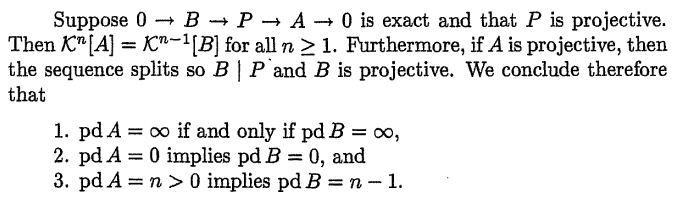
I've fixed the bivariate polynomial ring **R** and considered the ideal **I = < (x^3 + y)^2 , (x^2 + y^2)^2 , (x + y^3)^2 , (x*y)^2 >** . Hence I get the following short exact sequence
**0 >> I >> R >> R/I >> 0**
Here I expect that **pdim (I) = pdim (R/I) - 1** by the third item of the statement above. But when I do the computations on Macaulay2, it gives me **pdim (I) = pdim (R/I) = 2**. Is there a bug on the command pdim? or am I missing something? I've used the following code on M2.
Macaulay2, version 1.13
with packages: ConwayPolynomials, Elimination, IntegralClosure, InverseSystems, LLLBases, PrimaryDecomposition,
ReesAlgebra, TangentCone, Truncations
i1 : R = QQ[x,y];
i2 : I = ideal((x^3 + y)^2 , (x^2 + y^2)^2 , (x + y^3)^2 , (x*y)^2);
i3 : pdim (module I)
o3 = 2
i4 : pdim (R^1 / I)
o4 = 2
Contributor guide
No contributing guide indexed for this repository
First steps
- Read the whole issue, then the project's contributing guide.
- Comment on the issue to say you are picking it up — it saves two people doing the same work.
- Fork the repository and make your change on a branch.
- Open a pull request that references the issue number.
Assessment
This issue has not been assessed yet.