Counter-intuitive operation of ozone with PHS
- Dominant language
- Fortran
- Stars
- 352
- Forks
- 361
- Avg merge
- 2d 21h
- Merged PRs (30d)
- 7
Description
### Brief summary of bug
Without PHS, when ozone is turned on (via "use_ozone = .true."), ozone stress leads to a decrease in stomatal conductance, which in turn leads to a decrease in canopy transpiration; that makes intuitive sense to me. However, when PHS is turned on, turning on ozone leads to an increase in canopy transpiration in many places. That is, a decrease in stomatal conductance actually leads to an increase in canopy transpiration.
### General bug information
**CTSM version you are using:** Code used in tutorial Feb, 2019 (some version of the release code?)
**Does this bug cause significantly incorrect results in the model's science?** Yes - but just with ozone and PHS both on
**Configurations affected:** Configurations that have both ozone and PHS turned on. PHS on is default in CLM50 and later, but ozone is off by default.
### Details of bug
I came across this in running some tests for the CLM tutorial in Feb, 2019, but never filed a bug for it. Both @danicalombardozzi and @djk2120 agree that this looks problematic.
This is shown in the two attached figures, which are difference maps of FCTR (with ozone minus without ozone), for the first day of a case created like this:
./create_newcase --case o3test_phs_noOzone --compset I2000Clm50Sp --res f45_g37 --run-unsupported
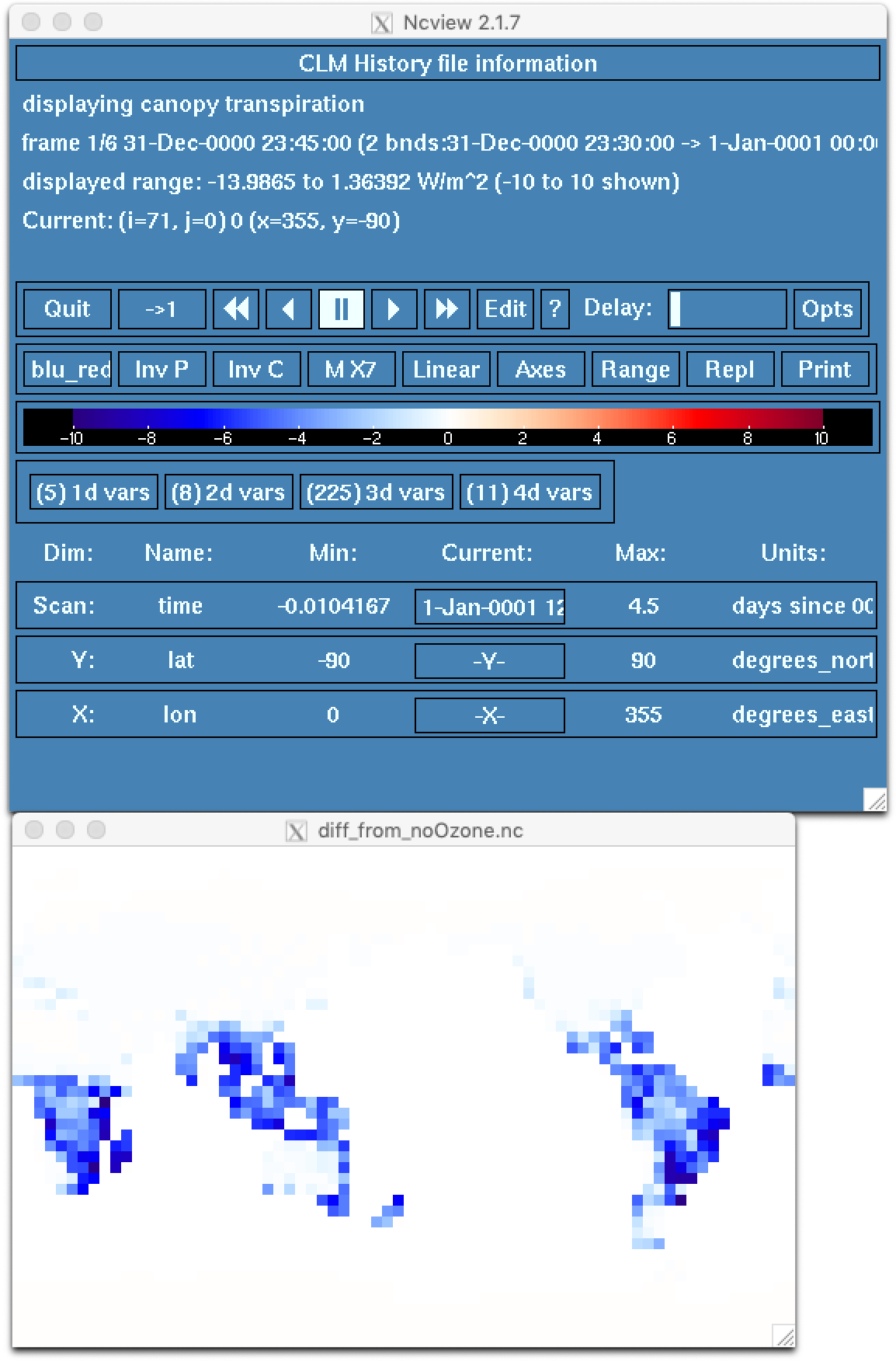
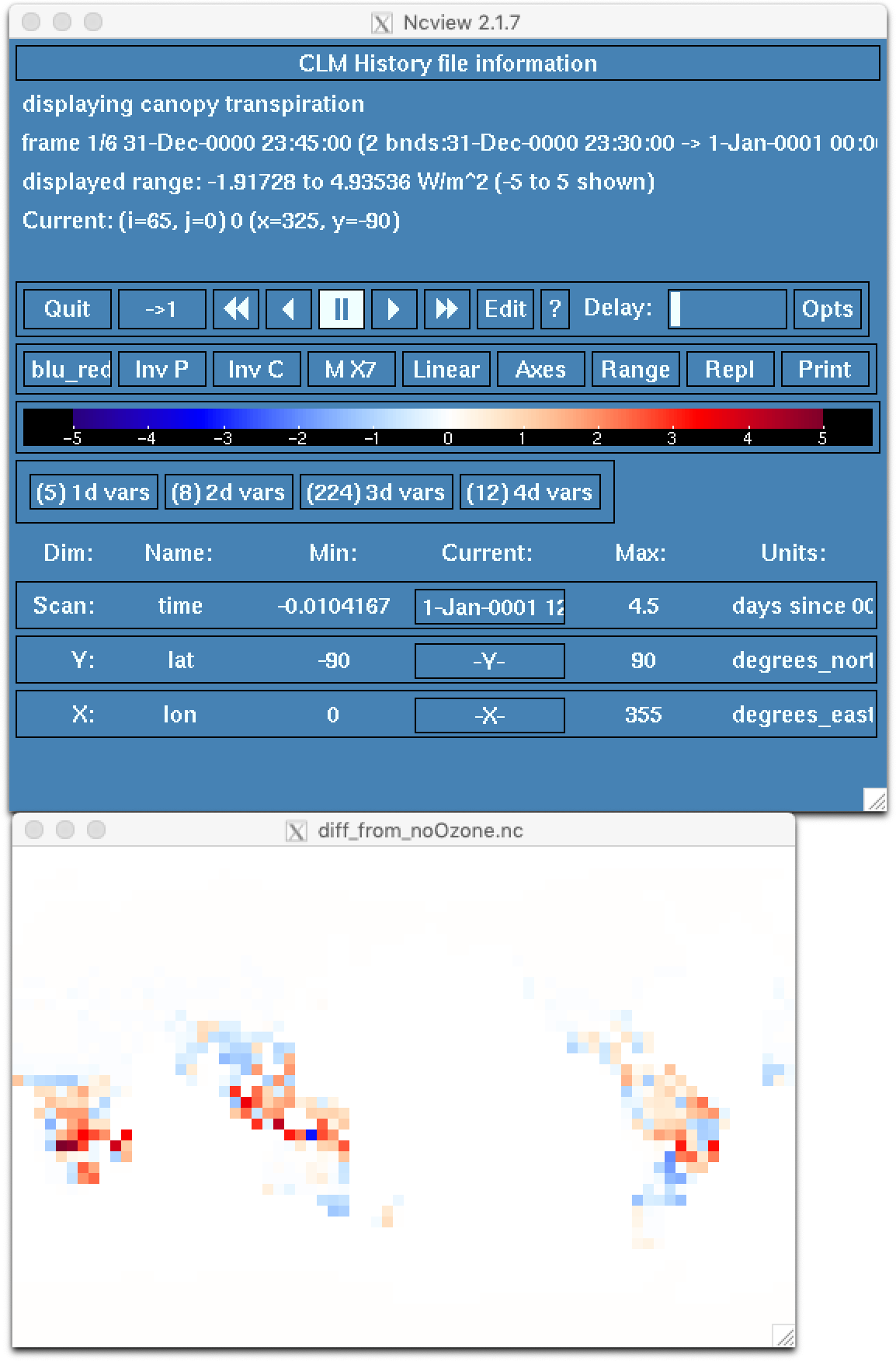
(The cases used daily history output, and differed in their settings of `use_ozone` and `use_hydrstress`.)
Also: I first ran into this via a slightly different test (more closely mimicking what I did for the tutorial): both cases had ozone on, but the experimental case had a stronger ozone effect just for o3coefgsun_patch – i.e., the ozone coefficient for conductance for sunlit leaves. When there was a greater decrease in just that coefficient, while leaving the shaded coefficient and the sunlit/shaded photosynthesis coefficients fixed, there was a nearly universal increase in transpiration when I ran the experiment and control with PHS, though (more intuitively to me) a universal decrease in transpiration without PHS.
When I originally reported this to @djk2120 , he replied:
> Yes, this is indeed counter-intuitive, and is not how PHS should be operating. I don't have any experience with the ozone code, but I will look into this...
>
> My expectation is that either:
> 1) PHS code is not running correctly with ozone on... (example: maybe ozone on is actually running SMS, or maybe ozone-on/PHS is running with ball-berry instead of medlyn), which would invalidate the ozone on - ozone off comparison
> 2) The canopy fluxes iteration is not converging nicely with PHS and ozone
>
to which I replied:
> Based on my understanding of the ozone code, I don't think (1) is the explanation: The ozone code is essentially a parameterization whose inputs are accumulated ozone in leaves, and whose outputs are four factors that feed into the photosynthesis calculation: o3coefvsha_patch, o3coefvsun_patch, o3coefgsha_patch and o3coefgsun_patch. I could be missing something, but I don't think there is anything in the ozone code that assumes particular parameterizations.
>
> (2) could be the case; I don't understand this well enough to comment.
>
Contributor guide
Assessment
This issue has not been assessed yet.